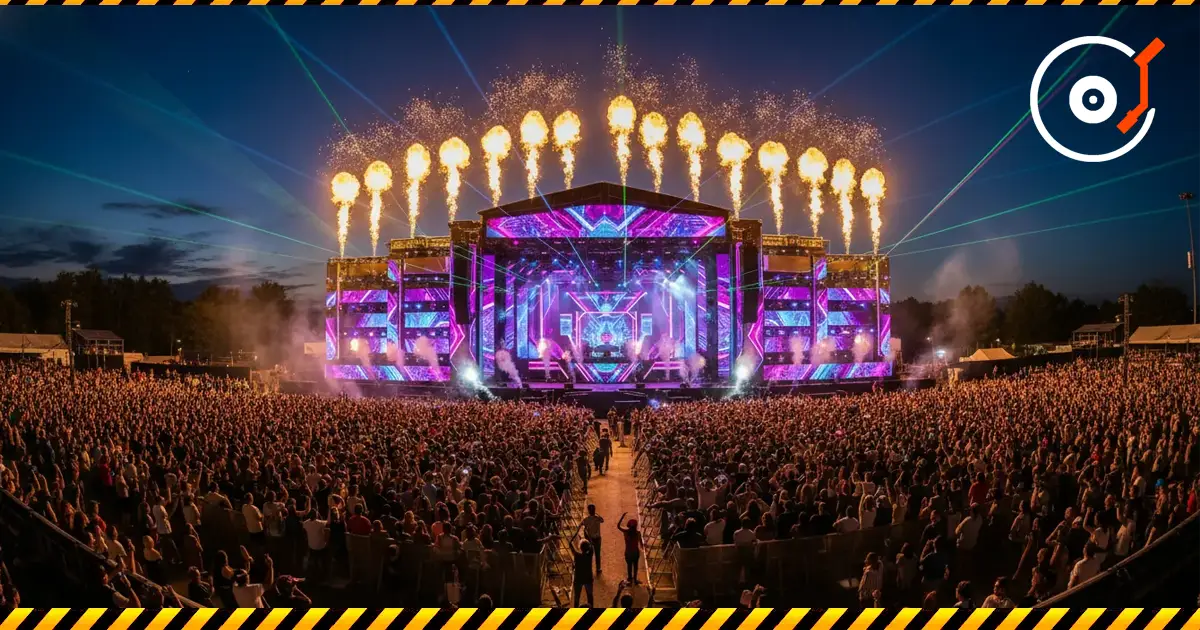
Big Room House is one of the defining genres of EDM, shaping the festival culture of the 2010s. Discover its history, track structure, key artists, and how the genre is evolving today.
Big Room House is one of the most recognizable and controversial genres in the modern electronic music scene. It became a symbol of the era of massive festivals, huge crowds, and instantly recognizable drops that make thousands of people explode in unison. But behind its apparent simplicity lies carefully engineered sound design and an entire cultural chapter of EDM.
What is Big Room House
Big Room House is a subgenre of EDM that emerged in the early 2010s at the intersection of progressive house and electro house. Its primary goal is to work on massive stages — hence the name “big room.”
Key characteristics:
- Tempo: 126–130 BPM
- Minimalist melodies
- Massive, “airy” drops
- Strong focus on kick and sub-bass
- Simple yet powerful track structure
This is music designed not for headphones, but for festival stages and stadiums.
History: From Underground to Mainstream
The rise of Big Room House is commonly associated with artists like Hardwell, Martin Garrix, and Swedish House Mafia.
Turning point:
- 2012–2013 — explosion of tracks like Animals and Spaceman
These releases defined the formula:
short build-up → tension → massive drop → repeat
Festivals like Tomorrowland and Ultra Music Festival became the main platforms for the genre’s growth.
By the mid-2010s, Big Room became the de facto standard of EDM festivals.
Technical Structure: How a Big Room Track is Built
Big Room House is not just about a “loud drop.” It is carefully engineered sound architecture.
1. Intro
- Often DJ-friendly (for mixing)
- Percussion + FX
2. Build-up
- Gradual tension increase
- Common tools:
- Snare roll
- White noise
- Pitch risers
3. Drop (key element)
- Minimal melody
- Main synth lead (often 1–2 notes)
- Huge kick + sub-bass
4. Breakdown
- Atmospheric pause
- Sometimes includes vocals
5. Second drop
- Repetition with variation
Sound Design: Why Big Room Sounds “Huge”
The Big Room sound is the result of precise work with frequencies and dynamics:
Main elements:
- Kick — punchy with a strong attack
- Sub bass — sidechained to the kick
- Lead synth — wide saw waves
- Reverb & Delay — create spatial depth
Typical tools:
- FL Studio
- Ableton Live
- Sylenth1
- Serum
Main principle:
less elements — more scale
Why Big Room Became So Popular
The popularity of Big Room House was not accidental but the result of a perfect alignment between musical form and the cultural context of the early 2010s. During this time, electronic music broke out of the underground and became a global festival phenomenon. Events like Tomorrowland and Ultra Music Festival started gathering tens and hundreds of thousands of people, and the industry needed a sound that could effectively work for such massive audiences.
Big Room turned out to be exactly that format. Its main strength lies in its clarity and immediate emotional impact. Unlike more complex subgenres that require attentive listening, Big Room acts directly: a short build-up creates tension, and the drop delivers a simple but powerful release. Even a first-time festival-goer instinctively understands when to jump — making the genre universal and globally accessible regardless of cultural background.
Artists like Hardwell and Martin Garrix also played a crucial role by structuring their sets around peak moments — drops designed for synchronized crowd reactions. Their performances evolved into full-scale shows with narrative flow, where each track became a tool to control the energy of massive audiences. Big Room became the “language” between DJs and the crowd.
The digital era amplified this even further. With the rise of YouTube, streaming, and social media, festival performances gained a second life online. Short clips featuring explosive drops and crowd reactions quickly went viral. Big Room’s structure is perfect for this — a single drop can become a standalone piece of content, accelerating the genre’s global spread.
Additionally, from a production standpoint, Big Room is relatively accessible. It doesn’t require complex harmony or layered arrangements, yet delivers powerful results with proper sound design. This led to an explosion of tracks, remixes, and variations, strengthening its dominance across DJ sets worldwide.
Ultimately, Big Room became more than just a genre — it became a symbol of an era when electronic music transformed into a global cultural force.
Criticism and Decline
Despite its massive success, Big Room House quickly faced criticism from both listeners and industry professionals. The main issue was the growing lack of diversity: producers increasingly relied on similar structures, identical synths, and nearly indistinguishable drops. This led to a “factory-like” feeling, where new releases lacked uniqueness. Even leading artists like Hardwell and Martin Garrix were criticized for predictability at certain points. Additionally, the commercialization of EDM contributed to this perception — Big Room became associated with festivals, sponsorships, and mass-market appeal rather than artistic innovation. As a result, listeners began shifting toward deeper, more experimental genres such as tech house, future bass, and harder techno styles. By the late 2010s, Big Room lost its dominance, though it remained relevant as a festival tool and foundation for hybrid genres.
Modern State: Big Room Techno and the New Wave
After its decline, Big Room didn’t disappear — it evolved. Today, we see its transformation into Big Room Techno, a hybrid style combining festival-scale energy with darker, more industrial techno elements.
This shift reflects audience fatigue with the overly polished EDM sound of the mid-2010s. Listeners began seeking heavier, more aggressive, and hypnotic sounds while still wanting the energy and structure of Big Room. The result is a fusion: powerful drops combined with groove, industrial kicks, acid elements, and more tension-driven minimalism.
Artists like Hardwell played a key role in this revival, returning with a harder, techno-influenced sound. Similarly, W&W incorporated harder styles, while Timmy Trumpet pushed toward more aggressive rhythmic structures.
The modern Big Room wave exists in a different media landscape. Instead of YouTube, platforms like TikTok and short-form video dominate. This influences track structure — drops are even more immediate and impactful to capture attention within seconds.
Big Room Techno is now part of a broader ecosystem and can be heard in:
- festival techno
- hard techno
- peak-time techno
- modern commercial EDM
Today, Big Room is no longer a standalone genre but a production approach used across styles.
It has evolved into a flexible framework — heavier, more mature, and better aligned with the tastes of the 2020s audience.
Interesting Facts
- Animals was created when Martin Garrix was only 17
- Big Room tracks are often designed specifically for festival sets
- Many tracks are tested live by DJs before official release
- The genre heavily depends on large-scale acoustics
Big Room House Today: Dead or Evolved?
Big Room House is not just a genre — it’s an era of electronic music that defined the 2010s.
Today it:
- is less dominant in charts
- remains essential for festivals
- actively blends with other styles
Conclusion
Big Room House is music on a massive scale.
Music designed to make thousands of people feel the same emotion at the same moment.
It has gone from:
- innovation → mainstream → reinvention
And judging by current trends, its story is far from over.
Big Room House continues to evolve — from classic festival anthems to techno-influenced new wave sounds. Want to feel its energy? Start listening now and share your favorite tracks and artists in the comments — let’s explore what the future of EDM will sound like together.