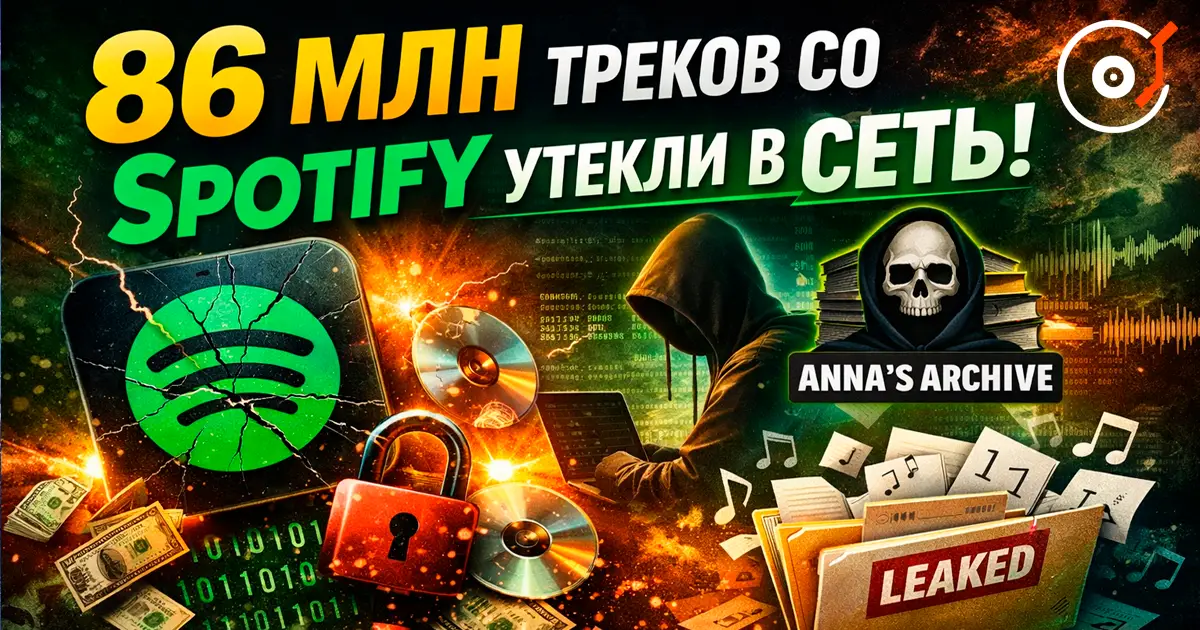
Anna’s Archive reported obtaining 86 million tracks and Spotify metadata. The company has launched an investigation. Why this is an alarming signal for the industry.
The non-profit project Anna’s Archive has reported the large-scale acquisition of content from the streaming platform Spotify. The dataset reportedly includes 86 million audio tracks and metadata for 256 million musical works. Spotify has acknowledged the fact of unauthorized access and announced the launch of an internal investigation.
The company clarified that a third-party entity was involved in the data collection, using automated tools, bypassing DRM mechanisms, and performing mass metadata extraction. Some of the accounts used in the process have already been blocked, and the platform’s security systems have been further strengthened.
Why Spotify Was Chosen
Anna’s Archive emphasizes that while Spotify does not cover all music ever created, it currently represents the most complete and structured entry point for building a centralized music archive. The service’s catalog includes tens of millions of recordings — from global hits to local and niche releases that are rarely preserved in physical archives or private collections.
The project’s creators state that their primary focus is music with low to medium popularity. According to them, these releases are the most likely to disappear without a trace when labels shut down, rights holders change, or licensing agreements are revised.
What Is Currently Available
For now, only metadata has been made publicly available. The published dataset contains information about artists, releases, and tracks, as well as 186 million unique ISRC codes — a volume exceeding that of most existing public music databases.
The first torrent file containing the metadata is 199.9 GB in size and is already being distributed by hundreds of users. Distribution of the audio files themselves is planned in stages, starting with the most popular tracks.
Why This Has Become a High-Profile Event
Spotify operates under a strict licensing model based on agreements with labels and rights holders. The mass extraction and potential distribution of its music catalog via torrent networks could become one of the largest episodes of digital piracy in recent years, far exceeding isolated leaks or individual user rips.
At the same time, Anna’s Archive continues to defend its position: streaming services, in their view, do not ensure long-term preservation of musical heritage. Catalogs can disappear or change radically due to business decisions, legal disputes, or shifts in rights ownership.
Risks for the Music Industry
The situation involving Spotify and Anna’s Archive is not merely a piracy incident, but a systemic challenge to the entire digital music distribution model.
1. A Threat to the Streaming Economy
If such archives become widespread, streaming may lose its key advantage — control over access. Even partial DRM circumvention undermines labels’ and investors’ trust in platforms as “secure repositories” for content.
2. Risks for Independent Artists
Paradoxically, independent musicians may be the most affected. Their releases are often not protected by dedicated legal mechanisms, and leaks deprive them of even minimal streaming income — especially in niche genres.
3. Devaluation of Licenses and ISRC Codes
The publication of large ISRC datasets and structured metadata facilitates:
-
automated catalog cloning;
-
authorship substitution;
-
grey-market distribution schemes.
This creates risks not only for streaming services, but also for digital stores, radio stations, and rights management systems.
4. Culture vs. Law
The argument of “preserving cultural heritage” is increasingly used to justify illegal content distribution. However, unlike libraries and archives, such projects lack:
-
a legal mandate;
-
transparent curation expertise;
-
accountability to creators.
5. Possible Consequences
Experts expect:
-
stronger DRM and API restrictions;
-
growth of closed ecosystems;
-
stricter conditions for third-party services and developers;
-
increased pressure on open music databases.
AI Context: Why This Leak Matters Beyond Music
Experts also highlight that such archives can be used not only for music distribution, but for training neural networks. According to researchers and digital rights activists, metadata and audio datasets of this scale represent an ideal labeled dataset for companies developing generative music models.
In particular, British composer and former Stability AI employee Ed Newton-Rex has previously stated that uncontrolled use of music archives for AI training could undermine the economics of copyright. In the case of Anna’s Archive, the issue goes beyond track copies — it involves a combined set of “audio + metadata + ISRC,” making such datasets especially valuable for machine learning.
Experts warn that if such archives are widely used to train generative music systems without rights holders’ consent, it will trigger a new phase of conflict between artists, labels, and the AI industry — extending beyond streaming and piracy.
From Books to Music: The Evolution of Anna’s Archive
It is also important to consider the evolution of the project itself. Anna’s Archive grew out of the Z-Library mirror infrastructure and initially focused on preserving and distributing books, academic publications, and textual materials. The move into music represents the project’s first large-scale expansion beyond text-based content.
This shift fundamentally changes how the initiative is perceived. While the project previously occupied a grey zone between academic archiving and piracy, working with licensed music from global streaming platforms places it in a zone of direct conflict with the music industry — with far greater economic scale and legal risks.
In effect, this is a test of whether the “archival activism” model applied to books can be extended to music — or whether the industry will respond far more aggressively.
The Spotify–Anna’s Archive incident shows that digital music is caught between two extremes — corporate control and radical archiving.
The question is no longer whether such leaks will happen again, but whether the industry can offer a legal model for long-term music preservation that satisfies both artists and listeners.
Editorial Note: Caution and Responsibility
The Minatrix.FM editorial team emphasizes that when covering such events, it is important to avoid direct links to archives, torrent files, or other access points to illegal content. Practice shows that search engines and advertising platforms may interpret such links as facilitating piracy.
This material is presented solely in an informational and analytical context — with a focus on risks for the industry, copyright, and the future of digital music.