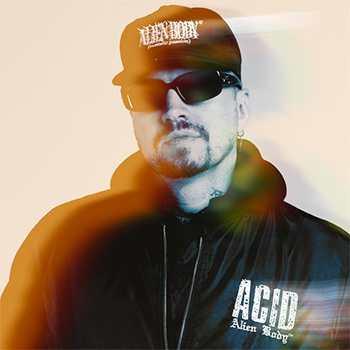
Pictureplane is the stage name of American electronic musician, artist, and designer Travis James Egedy, one of the key figures of the late-2000s and early-2010s American underground. His name is firmly associated not only with music, but with the formation of the aesthetics, terminology, and philosophy of a scene that would later become globally known as witch house.
Origins and early way of thinking
Travis Egedy was born on May 1, 1985 in Santa Fe, New Mexico — a region with a strong visual, mystical, and cultural identity. From an early age, he thought not in genres, but in spaces: sound, image, and the body were perceived as parts of a single artistic system.
He began making music as a teenager, using early digital tools and simple software. Even then, he was less interested in “clean production” and more focused on atmosphere, tension, and the sense of presence.
Denver, Rhinoceropolis, and the spirit of the era
A decisive stage came with his move to Denver, Colorado. There, Egedy found himself at the epicenter of a radical DIY environment and lived in the legendary art space Rhinoceropolis.
It is important to understand that Rhinoceropolis was not just a squat, but a true cradle of an entire cultural movement that united:
-
noise rock
-
art-dance
-
punk aesthetics
-
experimental electronic music
In this environment, noise and dance were inseparable, and music existed at the boundary between performance, ritual, and party. It was here that Pictureplane took shape as a project in which sound, visuals, and the body operate in sync.
Pictureplane as an artistic project
The Pictureplane project emerged in the mid-2000s and immediately went beyond “just electronic music.” Its sound combined:
-
techno and darkwave
-
gothic and occult visual language
Pictureplane tracks did not function as club tools, but as portals — invitations to enter a different state.
The birth of the term Witch House
One of the key historical moments is directly connected to Travis Egedy. In 2009, he introduced the term “witch house” as a joke while describing his own music and that of his friends. It was an ironic play on house music, but infused with a “witchy,” dark, and occult vibe.
The name was never meant to be taken seriously, but unexpectedly stuck, escaped the joke, and came to define an entire scene. Over time, the term took on a life of its own, and Pictureplane entered history as the point of origin of the genre’s very name.
The album Dark Rift (2009): the point of no return
The album Dark Rift became a turning point in Pictureplane’s career and in the entire early witch house scene. It is often described as a point of no return — the moment when an underground experiment turned into a cultural phenomenon.
A special place belongs to the track “Goth Star”, which:
-
became an anthem of the “internet goth” generation
-
spread rapidly through blogs and forums
-
samples Fleetwood Mac, creating an unexpected dialogue between pop heritage and dark electronic aesthetics
If one asks “where should I start listening to Pictureplane?”, the answer is almost always the same — “Goth Star.”
New York and the expansion of the medium
In the early 2010s, Egedy moved to New York, where his work became fully interdisciplinary. Pictureplane’s music began to actively intertwine with:
-
visual art
-
performance
-
fashion
It was here that the brand Alien Body emerged — not merely a clothing line, but an extension of the artist’s philosophy.
Alien Body and philosophy
For Travis Egedy, Alien Body is neither merch nor a fashion project in the traditional sense. He describes it as a form of “technological gnosticism” and “digital occultism.”
Within this system, clothing functions as:
a protective shell for the digital nomad,
an interface between the body, technology, and environment.
Thus, sound, clothing, and visuals become elements of a single mythology.
The pseudonym Pictureplane: meaning and metaphor
The name Pictureplane refers to a term from classical painting — the “picture plane”, the boundary between the viewer and the depicted world.
Egedy uses this metaphor deliberately: his music is not an object to be observed, but a space the listener must enter, crossing the boundary between reality and the artistic world.
Pictureplane — detailed discography
The discography of Pictureplane reflects not a linear “artist’s career,” but an evolution of artistic thinking — from DIY noise and lo-fi electronics to conceptual techno, dark electronic music, and philosophical post-club sound. Many releases appeared in underground formats, limited runs, or digital-only editions, typical of the scene from which he emerged.
Studio albums
Pictureplane (2004)
Debut album
A raw, experimental release in which the future project’s key traits are already visible: dark atmosphere, primitive electronics, noise textures, and a rejection of genre boundaries.
Covered in Blood, Surrounded by Text (2005)
A more aggressive and conceptual release. The music grows denser, with a sense of ritual and bodily tension.
Slit Red Bird Throat (2005)
One of the darkest and most extreme early albums, heavily influenced by noise, industrial aesthetics, and DIY punk.
Turquoise Trail (2007)
A more atmospheric and spatial album, introducing movement, landscape, and trance-like qualities.
Dark Rift (2009)
Key album / point of no return
The most important release in Pictureplane’s discography and a foundational album of early witch house.
Thee Physical (2011)
An album where sound becomes more bodily and rhythmically defined, strengthening its connection to techno and club culture.
Technomancer (2015)
A conceptual release focused on the interaction between humans, technology, and digital power structures.
Degenerate (2018)
A dark, dense, and socially charged album addressing alienation, identity, and digital decay.
Dopamine (2021)
A more minimalist and reflective release, referencing pleasure chemistry and digital addiction.
Sex Distortion (2025)
A late and conceptually mature release exploring:
-
physicality
-
sexuality
-
identity distortion
-
digital desire
Mixtapes and compilations
Thee Negative Slave Mixtape (2011)
A mixtape reflecting Pictureplane’s DJ and curatorial mindset.
Rare & Bloody (2013)
A collection of rare tracks and early experiments.
The Alien Body Mixtape (2014)
Directly connected to the philosophy and visual world of Alien Body.
How to listen to Pictureplane (editor’s recommendation)
-
For beginners:
→ Dark Rift → “Goth Star” -
For understanding the philosophy:
→ Thee Physical → Technomancer -
For the later period:
→ Degenerate → Sex Distortion
Interesting facts
-
Pictureplane is considered not only a genre pioneer, but the author of the term “witch house” itself.
-
Rhinoceropolis played a role for him similar to CBGB’s role in punk history.
-
“Goth Star” was one of the first electronic tracks whose popularity was entirely shaped by internet culture.
-
Egedy consistently avoided glossy mainstream exposure, even when his aesthetics were widely copied.
-
His projects are always conceived as complete worlds, not isolated releases.
Significance and influence
Pictureplane influenced:
-
witch house
-
dark electronic music
-
post-club and DIY scenes
-
the synthesis of music, visuals, and fashion
He became an example of an artist who creates a language, rather than merely using one.
Editorial conclusion from Minatrix.FM
Pictureplane is a figure of historical importance for electronic underground culture. He did not simply make music — he invented a term, an aesthetic, and a way of thinking that later became global.
His legacy is not charts or numbers, but a map of influence along which dark electronic culture continues to move.