




 Баста
Баста

Coldplay are a British rock band formed in London in the late 1990s. The lineup consists of Chris Martin — vocals, piano and guitar, Jonny Buckland — guitar, Guy Berryman — bass guitar, and Will Champion — drums and backing vocals. A special place in the band’s history belongs to longtime collaborator and creative director Phil Harvey, whom the musicians themselves describe as Coldplay’s fifth member.
Starting with intimate alternative rock built around melancholic vocals, guitar parts and piano, Coldplay gradually became one of the biggest live bands in the world. Over the course of their career, their music has moved through post-Britpop, alternative rock, electronic pop, ambient, dance-oriented styles and stadium pop rock. Yet the core of their sound has remained recognisable: Chris Martin’s melodies, Jonny Buckland’s expressive guitar playing and the band’s collaborative approach to songwriting.
Coldplay’s best-known songs include Yellow, Trouble, Clocks, The Scientist, In My Place, Fix You, Speed of Sound, Viva la Vida, Paradise, A Sky Full of Stars, Adventure of a Lifetime, Hymn for the Weekend, Something Just Like This, Higher Power, My Universe and feelslikeimfallinginlove.
University College London and the formation of the band
The story of Coldplay began at University College London, where the future members enrolled in the mid-1990s. Chris Martin and Jonny Buckland met while studying and quickly discovered a shared interest in music. Martin was writing songs and looking for musicians, while Buckland became his first permanent partner in what would eventually become the band.
Guy Berryman joined soon afterward. He initially studied engineering and later switched to architecture, but increasingly devoted his time to music. The last of the four core members to join was Will Champion, who studied anthropology. Before Coldplay, he played several instruments but was not a drummer. When the band needed someone behind the drum kit, Champion took on the role and eventually became one of its key members.
The musicians initially used other names. One of them was Starfish. Under that name, Chris Martin, Jonny Buckland, Guy Berryman and Will Champion played their first concert on January 16, 1998, at the London pub The Laurel Tree.
The name Coldplay was adopted later and remained with the band throughout the rest of its history.
Safety EP and the first recordings
In May 1998, the band independently released its debut EP, Safety EP. Only around five hundred copies were produced, many of which were distributed among friends, music-industry contacts and radio stations.
The release did not yet feature the polished sound that would later define Parachutes, but the main qualities of early Coldplay were already present: Martin’s emotional vocals, Buckland’s atmospheric guitar playing and a tendency to build songs around melody rather than instrumental virtuosity.
Chris Martin’s friend Phil Harvey played a major role in the band’s early development. He helped finance the first recordings, dealt with organisational matters and effectively became Coldplay’s first manager. His responsibilities later changed, but Harvey remained directly involved in the band’s creative and artistic decisions.
The next step was the single Brothers & Sisters, followed in 1999 by a deal with Parlophone and the release of The Blue Room EP. By that point, Coldplay had already attracted significant attention from the British music press and recording industry.
Parachutes and the breakthrough with Yellow
Coldplay’s debut studio album Parachutes was released on July 10, 2000. Most of the material was produced by Ken Nelson.
Early Coldplay music still contained little of the huge stadium sound that would later become associated with the band. The songs were built around acoustic and electric guitars, piano, a restrained rhythm section and Chris Martin’s high, emotionally exposed vocals.
The album included Don't Panic, Shiver, Spies, Sparks, Trouble, Everything's Not Lost and the song that changed the band’s career — Yellow.
Yellow
Yellow became Coldplay’s first major international success. Its simple guitar progression, Jonny Buckland’s expressive playing and Martin’s almost vulnerable vocal delivery stood out against the harder alternative music that dominated the turn of the millennium.
In the UK, the single reached number four. For a band that only two years earlier had been independently distributing a few hundred copies of its first EP, it represented a move to an entirely different level of recognition.
Parachutes topped the UK Albums Chart and earned Coldplay their first Grammy in the category of Best Alternative Music Album.
After the success of the debut album, Coldplay established a reputation as a melodic British alternative rock band, but the next record would significantly expand their musical boundaries.
A Rush of Blood to the Head
In August 2002, Coldplay released their second album, A Rush of Blood to the Head, which became one of the central works in the band’s discography.
While Parachutes relied heavily on softness and atmosphere, the new record had a much stronger sense of dynamics. Piano became as important as guitar, the rhythm section sounded more powerful and the songs gained a greater sense of scale.
The album opened with Politik, followed by In My Place, God Put a Smile upon Your Face, The Scientist, Clocks and other songs.
The Scientist
The Scientist became one of the most recognisable examples of Coldplay’s piano ballad style. Unlike many of the stadium-oriented songs that came later, the arrangement is deliberately restrained: most of the emotional weight is carried by Martin’s voice and the repeating chord progression.
The song gained further recognition through its music video, which tells its story in reverse. For the filming, Martin had to learn the lyrics backwards.
Clocks
Clocks is built around one of the most recognisable piano patterns in Coldplay’s catalogue. Instead of following the structure of a conventional guitar-rock single, the track develops around a continuously repeating keyboard figure and gradually increasing dynamics.
In 2004, Clocks won the Grammy Award for Record of the Year, becoming one of Coldplay’s biggest international achievements of their early career.
The album itself also won the Grammy for Best Alternative Music Album and firmly established Coldplay among the most prominent British bands of the early 21st century.
X&Y and the transformation into a stadium band
Coldplay’s third album, X&Y, was released in 2005. Its creation proved more difficult than the previous studio sessions, as the band spent a long time searching for the right sound and repeatedly reworked the material.
The final record sounded noticeably denser and larger in scale. While Coldplay’s first two albums left considerable space between instruments, X&Y relied on layered guitars, synthesizers, a powerful rhythm section and extended climaxes.
The album’s main songs included Speed of Sound, Fix You, Talk, The Hardest Part and the title track X&Y.
Fix You
Fix You gradually became one of Coldplay’s defining live songs. It begins with little rhythm section, centred on organ and Martin’s voice, before opening into a powerful finale with guitar, drums and group vocals.
This technique would later appear repeatedly in Coldplay’s music: an intimate beginning gradually builds tension and develops into a climax designed for the participation of tens of thousands of listeners.
Viva la Vida and collaboration with Brian Eno
After X&Y, the musicians decided to significantly change their usual recording approach. For the next album they invited Brian Eno, known both for his experiments in electronic music and his work with major rock bands.
The album Viva la Vida or Death and All His Friends was released in 2008. Alongside Eno, the material was developed with Markus Dravs and longtime Coldplay collaborator Rik Simpson.
The record became one of the most significant stylistic turns in the band’s history. Alongside guitars and piano came strings, bells, orchestral percussion, electronic layers, unusual guitar textures and compositions built around less conventional structures.
Violet Hill revealed a heavier side of Coldplay, 42 consisted of several clearly contrasting sections, while Life in Technicolor was almost entirely instrumental.
Viva la Vida
The defining song of this period was Viva la Vida. Instead of conventional rock guitar, its foundation is a repeating string arrangement, while the lyrics are narrated from the perspective of a ruler who has lost his power.
The track became Coldplay’s first single to reach number one on the UK chart and also topped the US Billboard Hot 100.
At the 2009 Grammy Awards, Viva la Vida won several awards, including Song of the Year, while the album was named Best Rock Album.
Viva la Vida or Death and All His Friends significantly expanded Coldplay’s sound while preserving the band’s enormous international audience.
Mylo Xyloto: colour, electronics and Paradise
In 2011, Coldplay released Mylo Xyloto. The collaboration with Brian Eno continued, but this time the group moved noticeably toward bright electronic pop.
The album was conceived as a story set in a fictional dystopian world. Its visual identity was built around graffiti, neon colours and a deliberately saturated palette.
The music reflected that mood. On Every Teardrop Is a Waterfall, an electronic loop was combined with live instruments; Charlie Brown became a large-scale concert anthem; and Princess of China featured Rihanna.
Paradise
Paradise became the album’s biggest international hit and Coldplay’s second single to top the UK chart.
The song captures the scale the band had reached by this stage: an orchestral introduction gives way to electronic rhythm, while the chorus is built for a crowd of tens of thousands to sing along.
By this point, the boundaries of alternative rock had become too narrow for Coldplay. The group increasingly combined rock, pop and electronic dance music.
Ghost Stories and A Sky Full of Stars
The next album, Ghost Stories, arrived in 2014 and differed sharply in mood from its predecessor.
After the colourful Mylo Xyloto, Coldplay turned toward restrained electronics, minimalist rhythms and more personal lyrics. The main songs included Magic, Midnight, True Love, Ink and Oceans.
Most of the album sounds considerably calmer than earlier Coldplay releases, yet it also produced one of the band’s most powerful festival songs.
A Sky Full of Stars and Avicii
A Sky Full of Stars was created with Swedish producer Avicii. His approach to electronic dance music helped combine Coldplay’s familiar piano opening with a dance rhythm and a huge climactic section.
Here, electronics no longer functioned merely as background or an additional production detail; they became one of the arrangement’s core elements.
In later work, Coldplay would continue integrating live performance with programmed electronic production even more actively.
A Head Full of Dreams
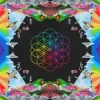
If Ghost Stories was restrained and introspective, A Head Full of Dreams, released in 2015, was almost its complete opposite.
Coldplay focused on bright pop melodies, funky guitar parts, dance rhythms and songs designed for large concert venues.
Adventure of a Lifetime was built around one of Jonny Buckland’s most rhythmic guitar lines, Hymn for the Weekend featured vocals from Beyoncé, Everglow returned the band to piano-ballad territory, while Up&Up closed the album with a large-scale multilayered composition.
A Head Full of Dreams Tour and Coldplay concerts
The tour supporting the album firmly established Coldplay among the world’s biggest stadium bands.
By this time, live shows had become an essential part of the band’s artistic identity. Synchronised glowing wristbands, confetti, lasers, giant screens and additional stages transformed the audience into a direct part of the performance.
Instead of the traditional format in which the crowd simply watches what happens onstage, Coldplay used almost the entire stadium as part of the show. Songs such as Fix You, Paradise, Viva la Vida and A Sky Full of Stars became shared performances between the band and tens of thousands of listeners.
Something Just Like This
In 2017, Coldplay released Something Just Like This with The Chainsmokers.
The track continued the electronic direction of A Sky Full of Stars, bringing the band even closer to contemporary pop and the electronic dance scene. A powerful synthesizer section replaced the usual guitar climax, while Martin’s recognisable melodic style kept the song connected to the rest of Coldplay’s catalogue.
Something Just Like This became one of Coldplay’s most popular songs on digital platforms and once again demonstrated the band’s ability to work naturally with modern pop production while preserving its own identity.
Everyday Life: a return to experimentation
After several years of bright stadium pop, Coldplay changed direction again. In 2019, the group released the double album Everyday Life, divided into two parts — Sunrise and Sunset.
The record became one of the most stylistically diverse in Coldplay’s discography. It incorporated gospel, folk, blues, orchestral music, African and Middle Eastern influences, experimental pop and almost unprocessed acoustic sections.
Key songs included Arabesque, Orphans, Trouble in Town, Daddy, Champion of the World and the title track Everyday Life.
Unlike the previous album, Coldplay did not accompany the release with a traditional global stadium tour. One of the reasons was the band’s desire to reconsider the environmental impact of large-scale touring.
Everyday Life served as a reminder that even after becoming one of the world’s biggest pop-rock bands, Coldplay had not abandoned experimentation or the possibility of releasing music not designed solely for major radio success.
Music of the Spheres
Coldplay’s ninth studio album, Music of the Spheres, was released in 2021. It was produced by Max Martin, one of the most successful songwriters and producers in modern pop music.
Coldplay once again turned to the concept-album format. The record was built around a fictional planetary system, with each world given its own musical and visual identity.
The main songs included Higher Power, Coloratura, People of the Pride and My Universe.
My Universe with BTS
My Universe, recorded with South Korean group BTS, became one of Coldplay’s most prominent international collaborations.
The song combined English and Korean lyrics, Coldplay’s live instrumentation and Max Martin’s synthesizer-driven pop production.
The track debuted at number one on the US Billboard Hot 100, once again demonstrating the scale of Coldplay’s international audience far beyond the traditional rock scene.
Music of the Spheres World Tour
In March 2022, Coldplay launched the Music of the Spheres World Tour, which became the largest live project in the band’s history.
The group approached its preparation differently from previous tours. After choosing not to mount a full tour for Everyday Life, Coldplay developed a programme aimed at reducing direct CO2 emissions associated with concerts, equipment transport and crew travel.
The touring infrastructure incorporated battery systems, solar panels, kinetic dance floors and specially designed bicycles that allowed members of the audience to generate part of the required energy. The glowing wristbands were adapted for collection and repeated reuse.
According to figures published by the band after the first two years of touring and independently reviewed by the MIT Environmental Solutions Initiative, direct CO2e emissions per show were approximately 59% lower than during the previous 2016–2017 stadium tour.
At the same time, the scale of the concerts only increased. Music of the Spheres World Tour became the most attended music tour in history, with around 13.2 million tickets sold by the end of its 2025 leg.
The journey from a first show in a small London pub to multi-year tours drawing millions of spectators clearly illustrates how dramatically Coldplay’s scale changed over the course of the band’s career.
Moon Music
On October 4, 2024, Coldplay released their tenth studio album, Moon Music. Max Martin once again served as producer.
The record continued the cosmic concept of Music of the Spheres, but its lyrics and overall mood placed greater emphasis on love, hope, acceptance and the attempt to preserve inner stability.
The first single was feelslikeimfallinginlove. The song develops in a recognisably Coldplay manner: a calm opening gradually grows into a broad, multi-voice finale.
On WE PRAY, the band is joined by Little Simz, Burna Boy, Elyanna and TINI. The song combines Coldplay’s pop-rock foundation with rap and several different vocal traditions.
GOOD FEELiNGS with Ayra Starr leans toward dance music and funk-pop, while ALL MY LOVE returns the group to a more traditional piano-song format.
The album closes with ONE WORLD, which features the voices of Coldplay fans from different countries. The idea of audience participation, long central to the group’s concerts, therefore also became part of the studio process.
Moon Music became Coldplay’s tenth consecutive studio album to reach number one on the UK Albums Chart. Every studio album by the band since Parachutes has therefore topped the national ranking.
The role of each Coldplay member
Although Chris Martin remains the vocalist and most recognisable member of Coldplay, the musical foundation of the band has throughout its history been built around four permanent musicians.
Chris Martin
Chris Martin is responsible for lead vocals, piano, a significant share of the guitar parts and the initial ideas behind many songs. His melodic style remains one of the most recognisable elements of Coldplay’s music.
Martin often works with relatively simple chord progressions and melodies that develop through repetition and gradual changes in dynamics. As a result, many Coldplay songs are not technically complex, yet they can sound particularly powerful in front of huge audiences.
Jonny Buckland
Jonny Buckland shaped the band’s distinctive guitar sound. He rarely builds parts around traditional rock solos. Instead, Buckland uses delay, reverb, repeated notes, higher registers and short melodic phrases.
The guitar plays very different roles in Yellow, In My Place, Fix You, Strawberry Swing, Hurts Like Heaven and Adventure of a Lifetime, but almost always remains part of the overall composition without trying to overshadow the vocal.
Guy Berryman
Guy Berryman handles bass guitar and plays a major role in defining Coldplay’s rhythmic stability. His parts are often deliberately concise, but in more groove-driven songs — such as Adventure of a Lifetime — the bass can become one of the central elements of the arrangement.
Will Champion
Will Champion is the drummer, a multi-instrumentalist and one of the band’s main backing vocalists. His role is especially apparent in concert, where the drums help turn initially intimate compositions into powerful stadium performances.
Champion also plays guitar and piano and contributes vocals, which reflects the collaborative nature of Coldplay’s working process.
Phil Harvey
Phil Harvey does not perform with the band as a regular stage musician, but occupies a special place within Coldplay’s internal structure. He was the group’s first manager, helped finance its earliest recordings and later focused on creative direction.
Coldplay officially refer to Harvey as their fifth member. He contributes to discussions about music, visual design, concerts and other creative decisions, remaining one of the group’s closest advisers.
How Coldplay’s sound changed
Throughout their career, Coldplay have repeatedly changed their sound, which means describing the group simply as an alternative rock band is most accurate only for the early period.
Parachutes was built around restrained guitar melancholy and post-Britpop. A Rush of Blood to the Head gave piano a more prominent role and increased the dynamic range. On X&Y, the large-scale stadium sound was fully established.
Viva la Vida expanded the palette with orchestral, electronic and experimental elements. Mylo Xyloto moved the group closer to electronic pop, while Ghost Stories took the opposite direction with more restrained and minimalist arrangements.
A Head Full of Dreams strengthened the dance and funk elements, Everyday Life once again brought experimentation and acoustic instrumentation to the foreground, while Music of the Spheres and Moon Music combined the familiar rock-band format with contemporary international pop production.
Despite all these changes, one principle has remained constant: the song itself is at the centre of Coldplay’s music. Electronics, unusual instruments and elaborate concert production enhance the melody rather than replace it.
Lyrics and major themes
Coldplay’s lyrics are rarely built around complex narratives. Chris Martin more often addresses universal human emotions and experiences: hope, loss, love, regret, loneliness, the desire for change and the need for closeness.
That simplicity makes the songs both accessible and open to different interpretations. Listeners in different countries can connect the same lines to their own lives and experiences.
The Scientist deals with the impossibility of repairing a relationship through reason alone, Fix You sounds like a promise of support, Viva la Vida explores downfall and the loss of power, while later songs such as Higher Power and ALL MY LOVE return once again to love as one of Coldplay’s central themes.
Grammy Awards and commercial success
Coldplay have won seven Grammy Awards. Among the most significant are the victories of Parachutes and A Rush of Blood to the Head in the Best Alternative Music Album category, Record of the Year for Clocks and Song of the Year for Viva la Vida.
The band’s record in its home country is especially notable: all ten Coldplay studio albums have reached number one on the UK Albums Chart.
On the main UK singles chart, the group reached number one twice — with Viva la Vida and Paradise. Many other Coldplay songs entered the Top 10 and remained popular long after their original release periods.
Coldplay studio discography
- 2000 — Parachutes
- 2002 — A Rush of Blood to the Head
- 2005 — X&Y
- 2008 — Viva la Vida or Death and All His Friends
- 2011 — Mylo Xyloto
- 2014 — Ghost Stories
- 2015 — A Head Full of Dreams
- 2019 — Everyday Life
- 2021 — Music of the Spheres
- 2024 — Moon Music
Selected key songs
- Yellow — 2000
- Trouble — 2000
- In My Place — 2002
- The Scientist — 2002
- Clocks — 2002
- Speed of Sound — 2005
- Fix You — 2005
- Talk — 2005
- Violet Hill — 2008
- Viva la Vida — 2008
- Every Teardrop Is a Waterfall — 2011
- Paradise — 2011
- Princess of China — with Rihanna, 2011
- Magic — 2014
- A Sky Full of Stars — 2014
- Adventure of a Lifetime — 2015
- Hymn for the Weekend — 2015
- Up&Up — 2016
- Something Just Like This — with The Chainsmokers, 2017
- Orphans — 2019
- Higher Power — 2021
- My Universe — with BTS, 2021
- feelslikeimfallinginlove — 2024
- WE PRAY — 2024
- ALL MY LOVE — 2024
The significance of Coldplay
Coldplay’s story stands out for the longevity and stability of its lineup. Four musicians who met while studying in London went from an independently released EP and pub concerts to the world’s largest stadiums while changing very little about the core lineup.
At the same time, Coldplay never turned the sound of Parachutes into an unchanging formula. At different stages, the band worked with Brian Eno, combined rock with electronic dance music, collaborated with Avicii and Max Martin, recorded with Rihanna, Beyoncé, BTS, Burna Boy and other artists, and explored ambient, gospel, funk and musical traditions from different parts of the world.
For some listeners, Coldplay are defined primarily by early songs such as Yellow, The Scientist and Clocks; others discovered the band through Viva la Vida, Paradise, A Sky Full of Stars or My Universe. The ability of different generations to find their own songs within the group’s discography has been one of the reasons for Coldplay’s unusually enduring popularity.
The live side of Coldplay is equally important. In their shows, the stadium has ceased to be merely a large venue for performing songs and has become part of the performance itself. The audience’s glowing wristbands, visual effects, additional stages and mass singalongs create an atmosphere in which the crowd participates in the event almost as actively as the musicians.
From the melancholic alternative rock of the turn of the millennium to the cosmic pop aesthetics of Music of the Spheres and Moon Music, Coldplay have continually changed form while preserving the essential goal: creating melodies that can be recognised within a few notes and bring huge audiences together. The combination of strong songwriting, an ongoing search for new sounds and a rare level of live scale has defined Coldplay’s place among the most important British bands of their generation.