


 Klaus Schulze
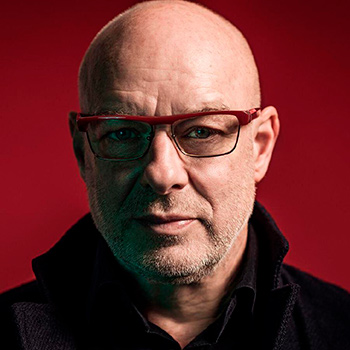
Brian Eno, full name Brian Peter George St John le Baptiste de la Salle Eno, was born on May 15, 1948, in Suffolk, England. He is a British musician, composer, producer, visual artist and art theorist, and one of the key figures in experimental and electronic music from the second half of the 20th century into the 21st. He first came to prominence in the early 1970s as a member of Roxy Music, then released a series of influential solo albums, helped define the modern concept of ambient music, and worked with David Bowie, Talking Heads, U2, Coldplay, Robert Fripp, David Byrne, Jon Hassell, Harold Budd and many other artists.
Eno has never limited himself to the role of a traditional instrumentalist. In practice, the studio became his primary instrument: magnetic tape, synthesizers, signal processing, delay systems, chance procedures and, later, computer algorithms. Many of his ideas — from ambient and generative music to the concept of the studio as an independent musical instrument — have had an influence far beyond the experimental scene.
Childhood and art education
Brian Eno grew up in Suffolk. At birth he was named Brian Peter George Eno; the additional names St John le Baptiste de la Salle were connected with his Catholic education and were added later.
He had no conventional musical education. In the mid-1960s, Eno enrolled at art school in Ipswich and later continued his studies at Winchester School of Art, graduating in 1969.
It was this artistic environment that shaped his future approach to music. Eno became interested in conceptual art and the work of John Cage, Cornelius Cardew, Steve Reich, Terry Riley and other experimentalists. He was particularly fascinated by tape recorders and by the possibility of creating a work not through traditional performance, but through recording, repetition and transformation of sound.
Eno would later repeatedly describe the tape recorder as his first real musical instrument. Even then, he was less interested in the question of «what to play» than in «what kind of system to create so that music can emerge within it».
The experimental scene of the late 1960s
Before Roxy Music, Eno took part in experimental ensembles and art projects. He was associated with Cornelius Cardew’s Scratch Orchestra, played clarinet in the Portsmouth Sinfonia, and experimented with magnetic tape, signal generators and electronics.
The Portsmouth Sinfonia was particularly close to his aesthetic: musicians in the orchestra were allowed to play instruments they had not mastered professionally. The result could sound strange or chaotic, but the process itself challenged conventional ideas about professionalism and musical skill.
This idea — restricting or altering the usual rules and then observing what happens — would later become one of the foundations of Eno’s creative method.
Roxy Music
In 1971, Brian Eno joined Roxy Music. His role differed from that of a conventional keyboard player. He worked with an EMS synthesizer, tape machines and electronic processing of the other musicians’ sound.
Alongside Bryan Ferry, Andy Mackay, Phil Manzanera, Paul Thompson and other members, Eno helped shape the early Roxy Music sound — a mixture of art rock, glam rock, pop, avant-garde ideas and futuristic electronics.
With Eno, the band recorded its first two albums:
- Roxy Music (1972);
- For Your Pleasure (1973).
His stage image was equally striking: vivid makeup, unusual clothing, feathers and deliberate theatricality. In early Roxy Music, Eno became almost as visually prominent as frontman Bryan Ferry.
After the second album, relations between Ferry and Eno became increasingly strained. In 1973, Eno left the band. Roxy Music continued without him, while he focused on solo work and experiments with studio sound.
Early solo albums
Eno’s debut solo album, Here Come the Warm Jets, was released in 1974. It was not yet ambient: the record was experimental art rock with elements of glam, eccentric lyrics and deliberately unconventional arrangements.
Later that year came Taking Tiger Mountain (By Strategy). Rather than maintaining a permanent backing band, Eno invited different musicians and treated the recording process as a studio experiment.
On Another Green World (1975), the balance between songs and instrumental music changed significantly. Much of the album consists of short atmospheric pieces. It was here that Eno’s transition from rock songs toward music based on space and timbre became especially clear.
Before and After Science (1977) completed the first major series of his vocal art-rock records. Nervous rock compositions sit alongside almost weightless pieces that anticipated his later ambient work.
Robert Fripp and delay systems
Even before fully developing his own ambient concept, Eno worked extensively with King Crimson guitarist Robert Fripp.
On the albums (No Pussyfooting) (1973) and Evening Star (1975), Fripp’s guitar was fed through tape-delay systems configured by Eno. Repeating fragments gradually accumulated on top of one another, forming extended fields of sound.
This technique became an important stage in the development of Eno’s approach to loops, gradual change and self-generating musical structures.
Discreet Music and the road to ambient
One of the turning points was the album Discreet Music (1975). Its long title piece was based on several simple melodic lines passing through a delay system and interacting with almost no constant intervention from the performer.
The idea of music capable of unfolding by itself within a predetermined system would later continue in Eno’s generative projects.
This period is also connected with a well-known story about an accident. After an injury, Eno spent some time recovering at home, where a recording of harp music was played for him. The music was very quiet and blended with the ambient sounds of the room. Rather than turning up the volume, he listened to the combination and became interested in the idea of music that could become part of its environment.
However, saying that ambient was «invented» at that exact moment would be an oversimplification. Atmospheric, minimalist and functional music had existed long before Eno. His achievement was primarily to formulate his own concept of ambient and give the style the name that became established in modern musical culture.
Ambient 1: Music for Airports
In 1978, Eno released Ambient 1: Music for Airports — the album with which he formally launched his Ambient series and introduced the term into wider musical use.
Instead of conventional songs, the album consists of slowly evolving loops of piano and voices. Eno contrasted this music with traditional background «Muzak». It was not intended to impose a mood or demand attention, yet it could remain interesting when listened to closely.
Music for Airports had an enormous influence on the later development of ambient, electronic music, minimalism, sound design and contemporary music created for physical spaces.
The Ambient series
After Music for Airports, the Ambient name was used on several more releases:
- Ambient 2: The Plateaux of Mirror (1980) — with Harold Budd;
- Ambient 3: Day of Radiance (1980) — an album by Laraaji produced by Eno;
- Ambient 4: On Land (1982) — a darker and more abstract work by Eno himself.
These releases demonstrated that ambient did not mean one specific sound for Eno. It could take the form of piano music, processed zither, synthesizer spaces or compositions constructed from field recordings and barely recognizable sounds.
David Bowie and the «Berlin Trilogy»
One of Eno’s best-known collaborations was his work with David Bowie on the albums Low (1977), “Heroes” (1977) and Lodger (1979), later collectively referred to as the «Berlin Trilogy».
Eno was not, however, the producer of Low or “Heroes”. Those albums were produced by David Bowie and Tony Visconti. Eno contributed as a musician, a source of creative ideas and a co-writer of several compositions.
His contribution is especially noticeable on the instrumental side of Low, including «Warszawa», written by Bowie and Eno. On “Heroes”, their joint songwriting credits included the title track «Heroes», «Moss Garden», «Neuköln» and «The Secret Life of Arabia» with Carlos Alomar. On Lodger, the collaboration became even closer, with Eno credited as a writer on several songs.
In the 1990s, Bowie and Eno reunited for the conceptual album 1. Outside (1995).
Oblique Strategies
In the mid-1970s, Brian Eno and artist Peter Schmidt created Oblique Strategies — a deck of cards containing brief creative instructions.
The cards were intended for moments when work on a piece had reached a dead end. Instead of searching for the most obvious solution, a musician or artist could draw a random card and follow the suggested direction.
Eno himself used Oblique Strategies in numerous studio sessions, and the system became particularly well known through his work with Bowie and other artists. It remains one of the clearest examples of his desire to use chance as a genuine creative tool.
Talking Heads
In the late 1970s, Eno began working with Talking Heads. He produced three consecutive albums for the band:
- More Songs About Buildings and Food (1978);
- Fear of Music (1979);
- Remain in Light (1980).
Over those three years, the music of Talking Heads changed noticeably. It incorporated more cyclical structures, polyrhythms, electronic processing and influences from African music.
Remain in Light was especially important. Much of its material was not created as conventional songs with prewritten chord structures, but from repeatedly looped instrumental fragments over which vocals and additional parts were later developed.
My Life in the Bush of Ghosts
At the same time, Eno and Talking Heads frontman David Byrne recorded My Life in the Bush of Ghosts (1981).
Instead of using a conventional lead singer, they incorporated fragments of found recordings — radio broadcasts, sermons and other vocal sources — over rhythmically complex instrumental foundations.
The album became an important milestone in the development of studio sampling before digital samplers became standard tools in popular music.
In 2008, Byrne and Eno recorded another collaborative album, Everything That Happens Will Happen Today.
Jon Hassell and «Fourth World»
In 1980, Eno collaborated with American trumpeter and composer Jon Hassell on the album Fourth World, Vol. 1: Possible Musics.
Hassell combined electronic processing, minimalism, improvisation and musical traditions from different cultures. His concept of «Fourth World» also had a significant influence on Eno’s later work.
Harold Budd
An important part of Eno’s ambient catalogue came from his collaboration with composer and pianist Harold Budd.
After Ambient 2: The Plateaux of Mirror, they recorded The Pearl (1984), which also involved Daniel Lanois.
Budd’s slow, spacious piano style and Eno’s studio processing created one of the most recognizable forms of 1980s ambient music.
Apollo
In 1983, Brian Eno, his brother Roger Eno and Daniel Lanois created Apollo: Atmospheres and Soundtracks.
The music was originally intended for a documentary film about the Apollo programme. The album combines slow electronic spaces with an unusual use of guitar timbres reminiscent of American country music.
The composition «An Ending (Ascent)» eventually became one of Eno’s best-known instrumental works and has been used repeatedly in films, documentaries and television.
U2
Eno’s collaboration with U2 became one of the longest-running production relationships of his career.
Together with Daniel Lanois, he first produced the band on The Unforgettable Fire (1984). The producers helped U2 move away from the more straightforward post-punk sound of their early records toward spacious arrangements and studio experimentation.
The following projects included:
- The Joshua Tree (1987) — produced by Brian Eno and Daniel Lanois;
- Achtung Baby (1991) — Daniel Lanois with Brian Eno;
- Zooropa (1993) — Eno contributed to the recording and production;
- Original Soundtracks 1 (1995) — an experimental project released by U2 and Eno under the name Passengers;
- All That You Can't Leave Behind (2000) — produced with Lanois;
- No Line on the Horizon (2009) — Eno and Lanois again worked with the band as producers and writers.
Eno influenced not only U2’s sound but also their approach to the studio: many compositions grew out of improvisations, accidental discoveries and extended editing of recorded material.
Windows 95
One of Brian Eno’s shortest yet most widely heard works appeared in 1995. He composed the startup sound for the Microsoft Windows 95 operating system.
The task was unusual: to create a musical fragment only a few seconds long that would simultaneously feel optimistic, modern and universal.
Eno later recalled preparing dozens of variations. The miniature ultimately selected became one of the most recognizable computer startup sounds of the era.
Generative music
From the 1990s onward, generative music occupied an increasingly important place in Eno’s work. In such a system, the composer does not fix the final work in its entirety, but instead creates a set of rules, parameters and sound elements that are then combined automatically.
Eno did not invent algorithmic composition, but he became one of its best-known popularizers outside academic music.
The principle was used in his installations, software and later recordings. One of the best-known projects was 77 Million Paintings — an audiovisual work in which images and music continually generate new combinations.
Together with developer Peter Chilvers, Eno released the musical applications Bloom, Trope and other programs. In 2017, a generative version of Reflection appeared, capable of producing continuously changing music.
Coldplay
In the late 2000s, Eno began working with Coldplay. Together with Markus Dravs, he became one of the principal producers of the album Viva la Vida or Death and All His Friends (2008).
For Coldplay, the collaboration brought a noticeable change in studio practice: the musicians were encouraged to alter their usual roles, try unfamiliar instruments and record under unconventional conditions.
Eno continued to contribute to the group’s work during the period of Mylo Xyloto (2011).
Albums of the 1990s and 2010s
Eno’s solo career continued throughout this period. In 1992, he released Nerve Net and The Shutov Assembly — two very different records: the first more rhythmic and electronic, the second based on slow instrumental spaces.
In 1993 came the minimalist Neroli, consisting of a single extended composition.
The Drop (1997) continued his experiments with instrumental electronics, while Another Day on Earth (2005) became his first major album in many years to feature his own vocals prominently.
In 2010, he recorded Small Craft on a Milk Sea with Jon Hopkins and Leo Abrahams.
This was followed by Drums Between the Bells with poet Rick Holland (2011), the solo ambient album Lux (2012), and two collaborative albums with Karl Hyde of Underworld — Someday World and High Life (both 2014).
The Ship and Reflection
In 2016, Eno released The Ship — one of his most ambitious later works. The album addresses war, human overconfidence and the catastrophes of the 20th century. Its second part includes an unusual version of the Velvet Underground song «I’m Set Free».
It was followed by Reflection (2017) — an extended ambient composition that also served as the basis for a generative application.
By this period, the boundary between album, software and sound installation in Eno’s work had become increasingly fluid.
Mixing Colours
In 2020, Brian Eno and his younger brother, composer Roger Eno, released the album Mixing Colours.
Roger recorded piano parts, which Brian then edited and processed. The result was an intimate, restrained work positioned between contemporary neoclassical music and ambient.
FOREVERANDEVERNOMORE
In 2022, Eno released FOREVERANDEVERNOMORE, his twenty-second solo studio album. Unlike much of his later instrumental work, he sings on most of the tracks.
The main themes of the record are the climate crisis, humanity’s relationship with nature and the possible future of civilization. Musically, the album combines ambient, electronic song forms and choral textures.
Secret Life with Fred again..
In 2023, Eno released the collaborative album Secret Life with British electronic producer Fred again...
It is a quiet, predominantly atmospheric record, markedly different from Fred again..’s club-oriented work. The album demonstrated Eno’s characteristic ability to collaborate with musicians from much younger generations without attempting to recreate his own earlier recordings.
The film Eno
In 2024, the documentary film Eno, directed by Gary Hustwit, premiered.
The project was built around a principle directly connected with the musician’s own creative ideas: a special generative system creates a new version of the film for each screening from a large pool of interviews, archival footage and other material.
As a result, different screenings of Eno can feature different edits and sequences of scenes. An official soundtrack was also released, combining recordings from different decades with previously unreleased material.
Luminal, Lateral and Liminal
Brian Eno and British-American artist and musician Beatie Wolfe met in the early 2020s through their shared interest in environmental and artistic projects and began making music together in 2023. The first full-length results of the collaboration appeared in 2025.
On June 6, two albums were released simultaneously — Luminal and Lateral. The former represents the more vocal and song-oriented side of the project, while Lateral is structured as an extended ambient work.
On October 10, 2025, a third collaborative album followed — Liminal, combining approaches from the two previous records.
In 2026, the collaboration continued with the single Afterlife. Eno and Wolfe did not conclude their joint project with the 2025 trilogy and have continued working on new material.
Visual art
Music has never been Eno’s only field of activity. His art education has remained an important part of his practice throughout his career.
He creates light works, video installations and environments in which image and sound change over time. His exhibition projects have been presented in museums, galleries and public spaces in different countries.
These works use many of the same principles as his music: gradual change, a limited set of initial elements, chance and systems capable of independently generating new combinations.
Production method
Eno has rarely worked like a conventional producer whose main task is simply to achieve a technically polished recording. He has been more interested in changing the underlying logic of how musicians work.
He might reject an already completed arrangement, ask band members to switch instruments, propose building a song from a spontaneous improvisation or deliberately restrict the available options.
This approach helps explain why Eno’s work with Talking Heads, U2 and Coldplay sounds so different from project to project. His «signature sound» is not a particular effect or synthesizer, but a method of creating conditions in which an artist begins to work differently.
Main solo discography
- Here Come the Warm Jets (1974)
- Taking Tiger Mountain (By Strategy) (1974)
- Another Green World (1975)
- Discreet Music (1975)
- Before and After Science (1977)
- Music for Films (1978; some of the material had previously existed in a limited edition)
- Ambient 1: Music for Airports (1978)
- Ambient 4: On Land (1982)
- Thursday Afternoon (1985)
- Nerve Net (1992)
- The Shutov Assembly (1992)
- Neroli (1993)
- The Drop (1997)
- Another Day on Earth (2005)
- Lux (2012)
- The Ship (2016)
- Reflection (2017)
- FOREVERANDEVERNOMORE (2022)
Key collaborative albums
- (No Pussyfooting) (1973) — with Robert Fripp
- Evening Star (1975) — with Robert Fripp
- Cluster & Eno (1977) — with Cluster
- After the Heat (1978) — with Dieter Moebius and Hans-Joachim Roedelius
- Ambient 2: The Plateaux of Mirror (1980) — with Harold Budd
- Fourth World, Vol. 1: Possible Musics (1980) — with Jon Hassell
- My Life in the Bush of Ghosts (1981) — with David Byrne
- Apollo: Atmospheres and Soundtracks (1983) — with Daniel Lanois and Roger Eno
- The Pearl (1984) — with Harold Budd
- Wrong Way Up (1990) — with John Cale
- Spinner (1995) — with Jah Wobble
- Drawn from Life (2001) — with J. Peter Schwalm
- The Equatorial Stars (2004) — with Robert Fripp
- Everything That Happens Will Happen Today (2008) — with David Byrne
- Small Craft on a Milk Sea (2010) — with Jon Hopkins and Leo Abrahams
- Drums Between the Bells (2011) — with Rick Holland
- Someday World (2014) — with Karl Hyde
- High Life (2014) — with Karl Hyde
- Finding Shore (2017) — with Tom Rogerson
- Mixing Colours (2020) — with Roger Eno
- Secret Life (2023) — with Fred again..
- Luminal (2025) — with Beatie Wolfe
- Lateral (2025) — with Beatie Wolfe
- Liminal (2025) — with Beatie Wolfe
Key production work
- Devo — Q: Are We Not Men? A: We Are Devo! (1978)
- Talking Heads — More Songs About Buildings and Food (1978)
- Talking Heads — Fear of Music (1979)
- Talking Heads — Remain in Light (1980)
- U2 — The Unforgettable Fire (1984, with Daniel Lanois)
- U2 — The Joshua Tree (1987, with Daniel Lanois)
- U2 — Achtung Baby (1991, co-production)
- U2 — All That You Can't Leave Behind (2000, with Daniel Lanois and other producers)
- Coldplay — Viva la Vida or Death and All His Friends (2008, with Markus Dravs and others)
Brian Eno’s significance
Eno’s influence is difficult to reduce to a single genre or group of albums. In Roxy Music, he helped bring avant-garde electronic ideas into glam rock. In his solo work, he turned studio processing into an independent method of composition. With Music for Airports, he formulated the concept of ambient in its modern sense. Together with Talking Heads, he experimented with polyrhythm and cyclical structures, while his work with U2 demonstrated how such methods could function within large-scale rock music.
His later experiments with generative systems gradually blurred the distinction between a musical recording and a program capable of producing an effectively endless number of versions of a work.
At the same time, Eno has consistently avoided presenting himself as a virtuoso musician. Performance technique interested him less than the structure of the creative process itself. For this reason, his influence can be felt not only in ambient or electronic music, but also in production, sound design, computer art and contemporary studio practice.
More than half a century after the emergence of Roxy Music, Brian Eno continues to release new recordings and work with artists from different generations. His later albums do not sound like attempts to repeat Music for Airports or Another Green World: the central idea remains much the same as it was at the beginning of his career — to create a system within which music can lead both its creator and its listener somewhere they had not planned to go.