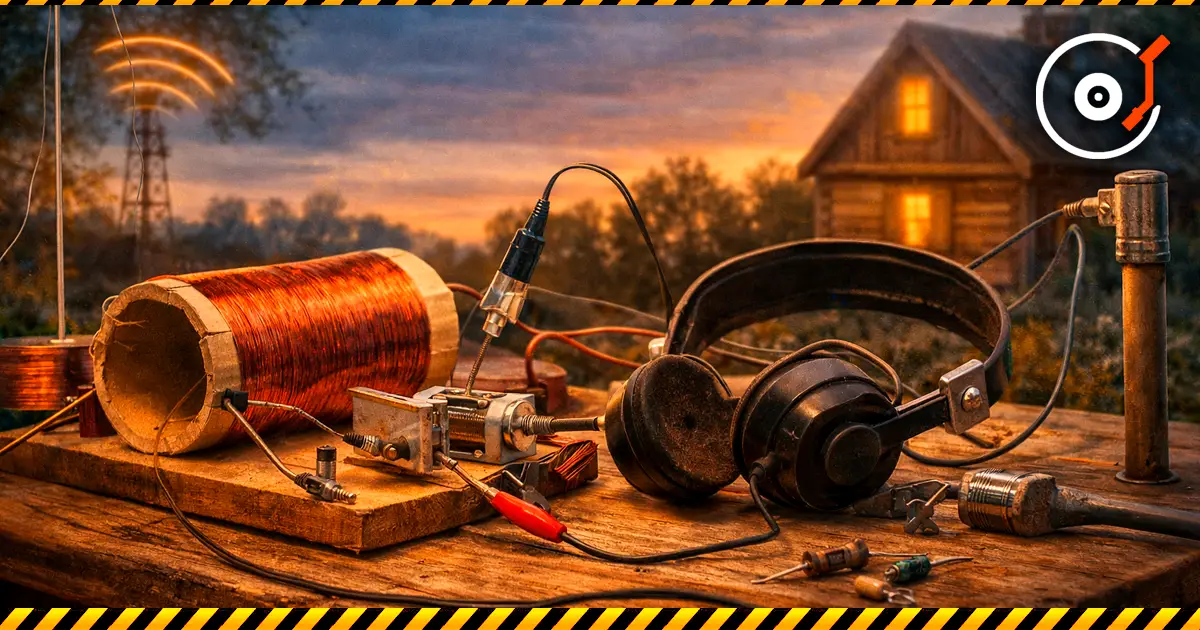
Step-by-step guide on how to build a DIY radio without batteries. Circuit diagram, components, and tips to improve signal reception and tune AM stations.
Building a radio with your own hands is not only an exciting experiment, but also a clear way to understand how radio waves work. Even using simple, readily available materials, you can create a fully functional receiver capable of picking up real radio stations without any external power source. Such a device is called a crystal (detector) radio receiver.
In this article, we will explore how to build a simple radio, what components you need, and how to achieve stable reception.
What is a simple radio (crystal receiver)
A crystal radio receiver is a device that:
- does not require batteries or external power
- uses the energy of radio waves
- receives signals in the AM band
Main components:
- antenna (captures the signal)
- coil (selects frequency)
- diode (rectifies the signal)
- earphone (produces sound)
This is one of the oldest and most reliable methods of receiving radio signals, used since the early 20th century.
What you need to build it
To make a DIY radio, you only need a few components:
- Copper wire (10–30 meters for the antenna)
- Wire for the coil (0.2–0.5 mm)
- Diode (1N34A, 1N4148 or equivalent)
- Earphone (preferably high-impedance)
- Coil base (bottle or tube)
- Ground connection (pipe, radiator, or ground rod)
All components are easy to find at home or buy for a low cost.
Simple radio receiver circuit
The circuit is extremely simple:
Antenna → Coil → Diode → Earphone → Ground
Step-by-step instructions
1. Coil winding
- Take a plastic bottle or tube
- Wind 50–100 turns of wire
- Leave taps (optional for tuning)
2. Antenna setup
- Use a long wire (10–30 meters)
- Place it as high as possible (window, balcony, tree)
3. Ground connection
- Connect a wire to a radiator or metal pipe
- This is critical for proper operation
4. Circuit assembly
- Antenna → coil
- Coil → diode
- Diode → earphone
- Earphone → ground
5. Finding a station
- Move the contact along the coil
- Adjust antenna length
- Reception is best in the evening
Why it works without batteries
Radio stations transmit signals as electromagnetic waves. The antenna captures them, and the signal energy:
- passes through the coil
- is detected by the diode
- is converted into sound
In other words, you are literally listening to energy from the air.
How to improve reception
To make your radio work better:
- Increase antenna length (20–30 m is ideal)
- Use a good ground connection
- Add more turns to the coil
- Try different diodes (germanium works better)
- Use high-impedance earphones
Version with amplifier (for louder sound)
If the sound is too quiet, you can add:
- an amplifier (e.g., LM386)
- a battery (3–9 V)
- a speaker
This version provides comfortable listening.
Important notes
- Works only with AM stations
- Urban interference may affect reception
- Sound without amplification is quiet
- Requires a long antenna
Interesting fact
The first radio receivers in the early 20th century worked exactly this way — without power. People listened using earphones powered only by radio waves.
Editorial opinion
Building a simple radio is more than just a DIY project — it’s a way to experience physics in action. In the era of streaming and digital audio, such experiments help reconnect with the fundamentals of sound. This is especially valuable for musicians, DJs, and anyone working with audio — from analog signals to the digital world.