

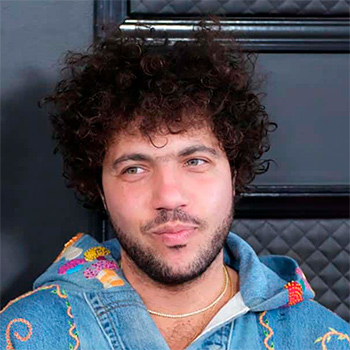
 Benny Blanco

Tommy Cash (real name — Tomas Tammemets; born November 18, 1991, in Tallinn, Estonia) is an Estonian rapper, singer, dancer and visual artist working at the intersection of hip-hop, experimental electronic music, techno, trap, gabber, Eurodance and pop. For many years, he styled his name as TOMM¥ €A$H, turning even his stage name into part of his visual identity. International recognition came through Winaloto, Pussy Money Weed, Little Molly, X-RAY, Zuccenberg, It's Crazy It's Party, TANGO and especially Espresso Macchiato, with which he represented Estonia at Eurovision 2025 and finished in third place.
From the beginning, Tommy Cash’s music has existed almost inseparably from imagery. A music video, clothing, photography, choreography, a stage persona or an art installation can be just as important to a project as the recording itself. Kumu Art Museum presents him specifically as an artist whose practice brings together pop culture, distorted representations of the human body, clothing, video, sound and spatial installations.
Over the course of his career, Cash has moved from the internet underground and small shows to collaborations with Charli xcx, Diplo, $uicideboy$, Rick Owens and Maison Margiela, major European festivals and Eurovision. Yet his core artistic formula has remained largely unchanged: a familiar cultural image is pushed toward grotesque exaggeration and transformed simultaneously into music, a joke, a visual object and a stage character.
Kopli, family and childhood in Tallinn
Tomas Tammemets grew up in Kopli, a district of Põhja-Tallinn with an industrial and working-class history. In an interview with Estonian television, Cash recalled that the area was considerably rougher during his childhood than it became later and that it taught him to constantly pay attention to the people around him and to what was happening in his surroundings.
His family background was mixed. GQ reported that Cash’s father is Russian and his mother Ukrainian. In other interviews, the artist has spoken about a more complex combination of Estonian, Russian, Ukrainian and other roots. That cultural ambiguity later became an important part of his work: he never sought to fit exclusively into an Estonian, Russian or American musical environment.
One of his first serious passions was dance. At around the age of fifteen, Cash began practicing hip-hop dance and later recalled that it was the first thing to give him a strong sense of freedom. Through dance culture came an interest in clothing, street culture and music. Before his professional music career began, he had already become a noticeable participant in Estonia’s dance scene.
Tammemets left regular school at around seventeen, studied art for a time, but did not complete that educational path either. Instead of following an academic route, he focused on dance, graffiti, visual art and, gradually, his own music. Before creativity became his profession, he also worked in restaurants and at a cinema.
Early recordings and Euroz Dollaz Yeniz
Tommy Cash began publishing his own music online in the early 2010s. ERR dates his first SoundCloud uploads to 2012, and one of his early notable tracks was Guez Whoz Bak.
His first full-length album, Euroz Dollaz Yeniz, was released on November 1, 2014. It contained nine tracks, including Leave Me Alone, Tokyo Drift, Euroz Dollaz Yeniz, Diablo, ProRapSuperstar and SugaSuga. Cash was not only the performer and songwriter, but also took part in the production of the material.
Even at this early stage, he deliberately avoided hiding his Eastern European background. Tracksuits, old cars, carpets, Soviet-era housing estates, Cyrillic lettering, cheap luxury and an intentionally exaggerated accent became artistic details. Rather than trying to resemble an American rapper, Cash built his own version of hip-hop out of Tallinn.
Music videos immediately became an important part of the work. In an interview with Vice, Cash said that he wrote his own video treatments and took part in editing; for example, Leave Me Alone used desolate Estonian outskirts as a visual extension of the feeling of isolation.
“Post-Soviet rap” and his attitude toward labels
As Tommy Cash became better known, the term “post-Soviet aesthetic” became closely associated with him. The description was easy to understand from the obvious visual elements of his early work — sportswear, housing estates, Eastern European everyday life and intentionally rough urban settings.
Cash himself, however, repeatedly treated that description critically. GQ noted that he was frustrated by the constant reduction of his biography and work to “post-Soviet” origins: the term turned a huge and highly diverse region into a handful of visual clichés.
His later career indeed demonstrated the limitations of that label. Cash’s music gradually absorbed techno, Eurodance, gabber, house, experimental pop and other styles, while his visual projects moved far beyond Eastern European street aesthetics.
Winaloto and the international internet breakthrough
A turning point came with Winaloto, released in 2016. The success of the song and its provocative music video moved Tommy Cash from the regional underground toward an international online audience. GQ and ERR both identify Winaloto as a key moment in his first major breakthrough outside Estonia.
The video used nude bodies, unusual poses and surreal compositions. Provocation was not simply an addition to the song, but an independent artistic method: the imagery was deliberately balanced between sexuality, absurdity and visual discomfort.
That same year, Cash began touring more actively outside Estonia. Long before Eurovision, his concert geography already included Europe, the United States and China, and he later performed at festivals such as Glastonbury, Sziget and Roskilde.
Charli xcx and the experimental pop scene
In December 2017, Tommy Cash appeared on Delicious from Charli xcx’s mixtape Pop 2. The collaboration connected him with a circle of artists and producers who at the time were actively reshaping electronic pop around intensely synthetic sounds, digital processing and exaggerated pop forms.
Cash later worked with Charli xcx again on Click, alongside Kim Petras. His music was increasingly perceived not simply as experimental Eastern European rap, but as something that naturally belonged next to the new international electronic pop scene. Apple Music also highlights Diplo, $uicideboy$, Boys Noize and Käärijä among Cash’s notable collaborators.
Pussy Money Weed and Little Molly
In 2018, two important works appeared — Pussy Money Weed and Little Molly. Both clearly demonstrated the move away from early trap toward a more experimental electronic environment.
In the Pussy Money Weed video, Cash worked with people with different physical characteristics and unconventional body types, placing at the center of the image those whom commercial pop culture rarely presents as standard representations of attractiveness. The provocative surface was combined with Cash’s recurring interest in who is represented in mass imagery and how.
Little Molly was released by PC Music on May 30, 2018. Its video centered on the digital transfer of Cash’s face onto numerous different characters, turning the surrounding world into a surreal version of the same person repeated over and over.
¥€$
The second studio album ¥€$ was released in 2018 and became the central work of Tommy Cash’s classic period. It combined his early rap foundation with techno, Eurodance, house, experimental electronic music and elements of more radical pop production.
Among its key tracks are X-RAY, Little Molly, Pussy Money Weed, Mona Lisa and Brazil. Cash worked on the album with Danny L Harle, A. G. Cook and Amnesia Scanner, among others. GQ noted that on ¥€$ his own control over the production process increased considerably.
X-RAY, created with Danny L Harle, is an especially clear example of the shift in Cash’s music: a heavy electronic rhythm and bright synthesizer line coexist with low spoken vocals and an almost pop-oriented melodic logic.
Rick Owens and contemporary art
At the same time, his musical career became increasingly intertwined with fashion. In 2018, Rick Owens invited Tommy Cash to walk in his menswear Spring 2019 show. Vogue later linked this meeting to the development of their subsequent creative collaboration.
In 2019, Cash and Owens presented the joint exhibition The Pure and the Damned at Kumu Art Museum in Tallinn. It ran from May 3 to September 15 and included both individual works by the two artists and pieces created specifically in collaboration.
The exhibition combined sculpture, clothing, objects, video, sound and spatial installations. For Tommy Cash, it became important confirmation that his visual practice could exist independently rather than merely as an extension of his music videos.
Maison Margiela
In 2021, Tommy Cash presented a joint project with Maison Margiela. The most widely discussed items were slippers designed to resemble real loaves of bread, as well as branded instant noodles. Vogue noted that the relationship between the artist and the fashion house developed gradually after Margiela used Cash’s music in one of its shows.
The project fit his approach to fashion perfectly: a cheap everyday object is transformed into a luxury designer item, while the viewer is left free to interpret the result simultaneously as a real fashion product and as an internet joke.
MONEYSUTRA
On April 9, 2021, Cash released the five-track EP MONEYSUTRA. It included Zuccenberg with $uicideboy$ and Diplo, Siri with BONES, Racked, Millionaire Mullet with RiFF RAFF and Nalik with Eldzhey.
Zuccenberg became especially notable, with Cash returning to a heavier trap-oriented sound. The international list of collaborators emphasized the position he had reached by that point: an artist moving freely between Europe’s experimental scene and American alternative rap.
That same year, he appeared on Turn It Up with Oliver Tree and Little Big. The collaboration brought together artists with different musical backgrounds but a similar attitude toward grotesque imagery, music videos and deliberately exaggerated stage characters.
Käärijä and the return to heavy club music
In 2023, Tommy Cash recorded It's Crazy It's Party with Finnish artist Käärijä. After the international success of Cha Cha Cha, the collaboration felt natural: both artists combine electronic music, rap, humor and physical performance.
This direction became part of a broader move by Cash toward heavier European club music. Conventional rap became less dominant in some releases, while gabber, techno, hard dance and repeated spoken phrases occupied more space.
TANGO, UNTZ UNTZ and HIGH FASHION
In 2024, Tommy Cash released several notable electronic tracks. Among them were TANGO with bbno$, Ass & Titties with Salvatore Ganacci and UNTZ UNTZ.
On November 20, 2024, the EP HIGH FASHION appeared. It consists of four tracks — Hottie, HIGH FASHION, Nostromo and Beat Rock.
The title directly connected two strands that had long intersected throughout his career — electronic music and high fashion.
Espresso Macchiato
On December 7, 2024, Tommy Cash released Espresso Macchiato, written together with Finnish songwriter Johannes Naukkarinen.
Instead of heavy experimental rap, the track was a short dance-pop song built around exaggerated Italian cultural symbols. Cash mixed English with deliberately incorrect Italianisms and created a caricatured character named Tomaso, for whom coffee, money, cigarettes and ostentatiously beautiful living all become part of the same comic image.
Artistically, the method remained familiar. In earlier work, Cash had exaggerated Western ideas about Eastern Europe; now he began applying the same approach to international ideas about Italy.
Eesti Laul and Eurovision 2025
At the national selection Eesti Laul 2025, Espresso Macchiato became the overwhelming favorite. In the superfinal, Tommy Cash received around 83% of the public vote and became Estonia’s representative at Eurovision.
Before the contest, the song sparked a noticeable debate in Italy: some public and political figures criticized its use of stereotypes. Cash emphasized that the work had been created out of affection for Italian culture rather than with the intention of insulting it.
At the Eurovision Song Contest 2025 in Basel, Cash first finished fifth in the first semifinal, then performed third in the final on May 17. He ultimately received 356 points and finished third, behind Austria and Israel. It was Estonia’s best result in more than twenty years and a national record for the number of points scored at the contest.
After Eurovision, Espresso Macchiato entered the British Official Singles Chart at No. 40, becoming the first UK Top 40 entry of Tommy Cash’s career.
After Eurovision: Tony Effe, OK and Figaro
The success of Espresso Macchiato significantly strengthened Tommy Cash’s connection with the Italian music industry. In 2025, an official version of the song featuring Italian rapper Tony Effe appeared, followed by the standalone single OK. Both releases are included in Cash’s official digital catalog.
On March 20, 2026, he released Figaro. The track was issued through Epic under an exclusive license to Sony Music Entertainment Italy, continuing the Italian direction that had developed after Eurovision.
L'AMMOR with TonyPitony
On April 17, 2026, Italian artist TonyPitony and Tommy Cash released the joint single L'AMMOR. The song continued the grotesque Italian aesthetic that had emerged around Espresso Macchiato, this time in the form of a full collaboration between two artists.
An intentionally absurd video was made for the track, with TonyPitony and Cash portraying a surreal couple and staging a parody wedding. The project also received its own eight-bit video game, L'AMMOR – The Game.
Boyband with Joost and Käärijä
On May 11, 2026, Joost Klein, Käärijä and Tommy Cash released the collaborative three-track project Boyband. Apple Music classifies it as a single rather than an EP. It contains I Miss Us, 2000 and Mass Destruction.
The collaboration made sense not only because of the artists’ shared Eurovision connection. All three work with contemporary European club music, internet culture and characters in which humor and deliberate strangeness are part of the musical work itself.
Visual language
One of the recurring themes in Tommy Cash’s art is the human body. It can be digitally transferred onto another character, enlarged, distorted, turned into sculpture or placed inside an unfamiliar advertising composition. Kumu identifies precisely this interest in altered and distorted bodies as one of the central characteristics of his visual practice.
Another constant element is the collision between high and low culture. Designer clothing can exist next to cheap everyday objects, a museum installation alongside an internet meme, and a collaboration with a major fashion house alongside a loaf of bread or a packet of noodles.
That is why the traditional separation between serious art and a joke works poorly in Cash’s case. Humor is an artistic tool for him, while an art object is often intentionally designed so that it first appears to be a joke.
Musical style
Tommy Cash’s early work was based mainly on rap and trap, but by the time of ¥€$ his music had expanded considerably to include techno, Eurodance, house, happy hardcore and experimental electronic music. Later, gabber and other heavier forms of European club music became even more prominent.
At the same time, Cash’s rap has never been built exclusively around lyrical technicality. Timbre, accent, rhythm and short spoken phrases are equally important. He does not try to completely hide his non-native English pronunciation and often deliberately intensifies it, turning the accent into a musical characteristic of its own.
Espresso Macchiato brought this principle into its most mainstream form: deliberate linguistic mistakes and the mixing of languages became not merely a feature of the performance, but the foundation of the entire song.
Dance and stage performance
Cash’s many years of experience as a dancer noticeably distinguish him from many rap performers. Dance entered his life before professional music and continues to influence the way he behaves onstage.
Movement is not used merely as concert choreography around a singer. Body position, facial expression, repeated gestures and interaction with other characters often become part of the dramatic structure of the performance itself.
This was especially visible at Eurovision, where Espresso Macchiato was built not around a vocal showcase, but around a fully developed comic character, precise movements and the gradual unfolding of a visual story.
Main Tommy Cash discography
- Euroz Dollaz Yeniz — 2014, studio album
- ¥€$ — 2018, studio album
- MONEYSUTRA — 2021, EP
- HIGH FASHION — 2024, EP
- Boyband — 2026, three-track collaborative single by Joost, Käärijä and Tommy Cash
In Apple Music’s official catalog, Cash’s main full-length albums remain Euroz Dollaz Yeniz and ¥€$.
Main songs by Tommy Cash
Among his most significant recordings are Guez Whoz Bak, Leave Me Alone, Euroz Dollaz Yeniz, Winaloto, Surf, Pussy Money Weed, Little Molly, X-RAY, SDUBID, Zuccenberg, Racked, It's Crazy It's Party, TANGO, UNTZ UNTZ, Espresso Macchiato, OK, Figaro, L'AMMOR, I Miss Us, 2000 and Mass Destruction.
Collaborative tracks on which Cash appears as a featured artist also occupy an important place in his catalog: Delicious and Click by Charli xcx, Turn It Up with Oliver Tree and Little Big, as well as other projects from the international electronic and alternative rap scenes.
Tommy Cash’s place in contemporary European music
Tommy Cash built an international career in an unusual way. Instead of trying to erase his regional background and make completely neutral English-language pop, he initially turned his own difference into the central material of the project — Tallinn, Kopli, Eastern European everyday life, his accent, his dance background and strange visual humor.
Winaloto brought this aesthetic to an international internet audience. His collaboration with Charli xcx connected Cash with the experimental pop scene, ¥€$ expanded his musical palette, while working with Rick Owens and exhibiting at Kumu firmly established his position at the intersection of music, fashion and contemporary art.
Eurovision was not a rejection of his previous method, but its most mainstream variation. Espresso Macchiato used the same logic of cultural exaggeration on which many earlier Cash works had been built, but placed it inside a highly accessible dance-pop form. The result was third place and 356 points — Estonia’s best Eurovision result in more than two decades.
At the same time, the later Figaro, L'AMMOR and Boyband showed that Cash did not become fixed exclusively in the role of a “Eurovision artist.” His catalog continues to move between pop, rap and heavy European electronic music, while the visual component remains inseparable from the sound.
For that reason, Tommy Cash is more accurately understood not simply as an Estonian rapper, but as a musician and visual artist who uses popular culture as material for continuous reinterpretation. From Kopli and Euroz Dollaz Yeniz to Rick Owens, Maison Margiela, Espresso Macchiato and Eurovision, his career has developed around the same core ability — turning the collision of seemingly incompatible cultures, genres and images into a language that is distinctly his own.