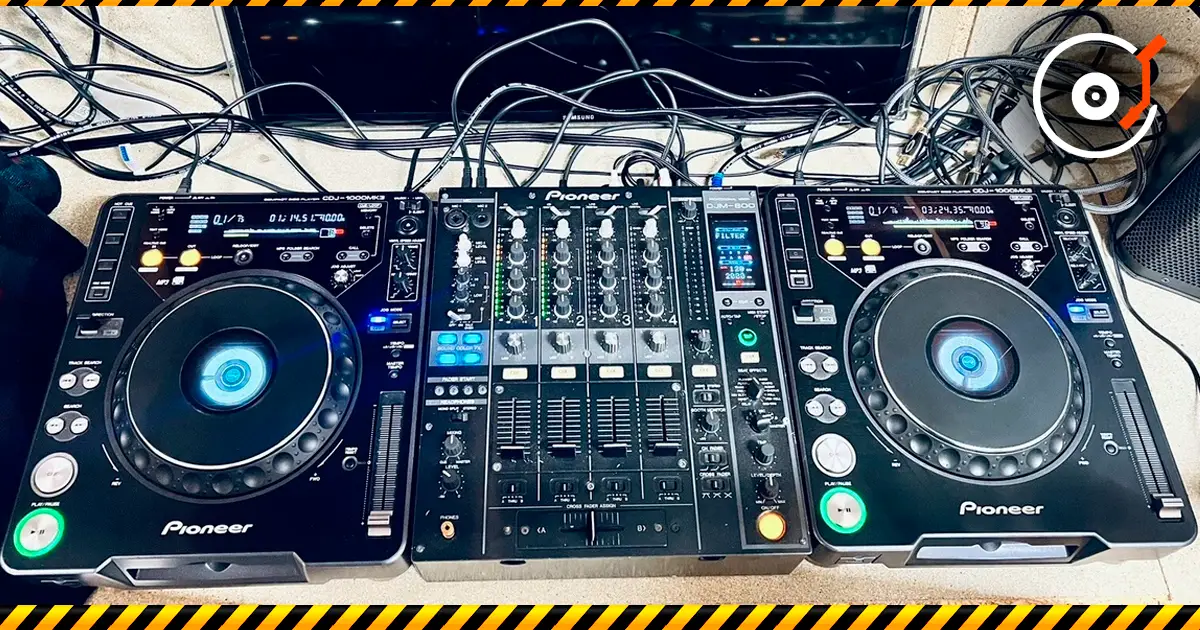
How the CDJ-1000 and DJM-800 combo changed the world of DJing, killed vinyl snobbery, and created the gold standard of club DJ setups. Read an expert breakdown on Minatrix.FM.
In the history of music technology, there are devices that don’t just become popular — they establish a professional standard. In the early 2000s, Pioneer DJ achieved exactly such a breakthrough by releasing a pairing that would define the look of club DJ booths for years to come: the Pioneer CDJ-1000 and the Pioneer DJM-800.
It was the moment when digital DJing stopped being a compromise — and became the industry norm.
CDJ-1000: the end of vinyl snobbery
Before the arrival of the CDJ-1000, the professional scene lived by a rigid rule: a real DJ plays only vinyl. CD players were associated with mobile discos and were not taken seriously due to the lack of tactile control.
Why the CDJ-1000 became a turning point
Vinyl Mode
Pioneer were the first to implement a large jog wheel with a touch-sensitive surface that mimicked the behavior of a vinyl record. DJs could stop a track by hand, scratch, and nudge the beat — with minimal latency, which was a major technological achievement in the early 2000s.
Display in the center of the jog wheel
For the first time, DJs could see the track position directly under their hand. The visual marker replaced the slipmat and made it possible to work almost without looking at the main screen.
SD cards and Hot Cue (MK3)
A lesser-known but important fact: the MK3 version allowed DJs to store cue points and track data on SD cards. In essence, this was a prototype of today’s flash-based ecosystem and Rekordbox-style workflow long before the USB era.
“When the CDJ-1000 became the club standard, I realized that digital was no longer the enemy of vinyl. It finally started behaving like an instrument, not just a player.”
Fact: the CDJ-1000 was the first digital player to be accepted in top artists’ technical riders without any “vinyl-only” clauses.
DJM-800: the mixer as a musical instrument
If the CDJ-1000 established trust in digital playback, the DJM-800, released in 2006, fundamentally changed the role of the mixer in a DJ set.
Key innovations
Sound Color FX — a revolution in mixing
Before the DJM-800, effects were global. Pioneer were the first to place filters and processing on dedicated knobs for each channel. Filter, Sweep, Crush, and Harmonic became part of the performance rather than occasional embellishments.
24-bit digital architecture
The mixer delivered clean, powerful sound even on large club systems and festival stages, where previous models would begin to break down sonically.
Legendary reliability
The DJM-800 became a symbol of club durability: years of operation in smoke-filled venues, spilled drinks, and extreme workloads — all without losing functionality.
“The DJM-800 turned the mixer into an active participant in the set. Before that, it was just a mediator between tracks.”
Fact: many DJM-800 units are still operating in clubs nearly 20 years after their release.
The birth of the “Pioneer Standard”
The most important impact of this pairing lies not only in technology, but in the standardization of the profession.
For the first time, a DJ flying from Tokyo to Berlin, from Ibiza to Kyiv, or from New York to Budapest knew:
- the Play and Cue buttons would be in familiar positions
- the resistance of the faders would feel the same
- the effects logic would be identical
This removed the stress of adaptation and allowed artists to focus exclusively on the music and the crowd.
A legacy that lives on
Modern flagships like the CDJ-3000 and DJM-A9 are evolutions of ideas first introduced in the era of the CDJ-1000 and DJM-800.
They proved that digital formats can be tactile, reliable, and creative — and most importantly, universal.
Conclusion: the CDJ-1000 and DJM-800 didn’t just change equipment. They changed the mindset of DJs and created the very “gold standard” by which the industry still operates today.