

 Русский Размер
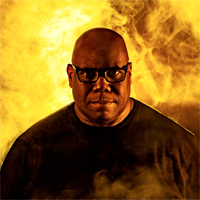
Carl Cox (full name Carl Andrew Cox; born 29 July 1962 in Oldham, England) is a British DJ, producer, radio broadcaster and record label owner, widely regarded as one of the defining figures of the UK rave movement and the global techno scene. His career began in the late 1970s, long before the emergence of British acid house, and Cox built his international reputation through his pioneering three-deck mixing technique, extended DJ sets and ability to move effortlessly between techno, house, acid house, funk, disco and harder forms of electronic club music.
Genres: Techno, House, Acid House, Tech House
Occupation: DJ, producer, radio broadcaster, record label owner
Years active: late 1970s — present
From disco and soul to his first DJ sets
Although Carl Cox was born in Oldham in north-west England, much of his childhood and teenage years were spent in Carshalton, South London. Music was a constant presence in his family, while his parents’ Barbadian roots brought soul, funk, reggae and Caribbean rhythms into the British musical environment that surrounded him. Cox would later return to Barbados many times, where members of his family lived.
His interest in music began at a very early age. According to Cox’s own recollections, by the age of around ten he was already taking a small record player to school and playing records from his father’s collection. At fifteen, he bought a pair of turntables and began working as a mobile DJ. His early sets were centred on disco before expanding into soul, rare groove, early hip-hop and electro.
By the beginning of the 1980s, Cox was treating DJing not simply as a hobby but as a profession. He built sound systems himself, hired equipment out for parties and negotiated opportunities to play warm-up sets. At the same time, he still had to work outside the music industry, including jobs in a supermarket and on construction scaffolding.
Acid house and the British rave revolution
The arrival of early Chicago house in the UK became a turning point for Cox. During the mid-1980s, he began introducing new American house records into sets that had previously been built primarily around funk, soul and disco. One of the records that made a particularly strong impression on him was Phuture’s Acid Trax.
Cox found himself directly involved in the emerging British acid house movement. He performed at the first Shoom party launched by Danny Rampling after his return from Ibiza, took part in The Project alongside Paul Oakenfold and played at some of the biggest early raves.
Sunrise in 1988 became a particularly important moment in his story. During one performance, Cox connected a third turntable that had originally been intended as a backup and began incorporating it directly into the mix. His three-deck technique became one of his signatures and earned him the nickname The Three Deck Wizard.
Over the following years, he became one of the most in-demand DJs on the British rave scene, performing at both legal events and the illegal raves that defined much of the era. As dance culture gradually moved from warehouses and fields into established clubs, Cox increasingly shifted his musical focus towards techno.
“I Want You (Forever)” and the beginning of his recording career
In 1991, Carl Cox released the single I Want You (Forever) through Paul Oakenfold’s Perfecto label. The track reached No. 23 on the UK chart and led to an appearance on the television programme Top of the Pops. For an artist whose reputation had previously been built almost entirely on DJing, it marked his first major success as a producer.
Cox, however, did not build his career around commercial pop-house. As the British scene fragmented into trance, hardcore, jungle and other styles, he increasingly gravitated towards techno and club-focused electronic music.
Another landmark release was the 1995 mix album F.A.C.T., which cemented Cox’s position not only as a rave DJ but also as one of the international representatives of a new generation of techno. It was followed by his own studio albums At the End of the Cliché (1996), Phuture 2000 (1999), Second Sign (2005) and All Roads Lead to the Dancefloor (2011).
There has never been a rigid dividing line between house and techno in his production work. Depending on the period, Cox’s music has drawn on acid lines, breakbeats, harder club rhythms or a more funk-driven groove — an element that has remained part of his musical language since his early years playing disco and soul.
Intec and building his own techno infrastructure
By the end of the 1990s, Carl Cox had developed from an artist into a fully established figure within the music industry. His label Intec Records, focused primarily on techno, began operating in 1999. After the original incarnation of the label closed in 2006, it returned in 2010 under the name Intec Digital.
Through Intec, Cox not only released his own music but also consistently supported and worked with other producers. The label went through several periods of activity and hiatus before being relaunched once again in April 2025. The first release of its new chapter was the Chasing Ghosts EP by Carlo Lio and M.I.T.A.
Another venture followed in 2018 with the launch of Awesome Soundwave (ASW), founded together with Australian musician Christopher Coe. Unlike Intec, the label was created specifically as a platform for electronic music performed live using synthesisers, drum machines and other hardware.
Fifteen years at Space Ibiza
The longest-running club chapter of Cox’s career is closely associated with Space Ibiza. In 2001, he was given his own regular night at the club, and the residency gradually developed into one of Ibiza’s most celebrated techno programmes. Cox was not only the headline artist but also played an active role in selecting guests and shaping the musical direction of the nights.
The residency ran for 15 consecutive seasons, from 2001 to 2016. During that period, Cox’s events hosted artists from multiple generations of house, techno, drum & bass and electronic music, while Space itself became one of the defining venues of his international career.
The final night of his residency took place on 20 September 2016. Just a few weeks later, Space itself closed in its historic form. For Cox, the moment marked the end of an era in which his name and the club had effectively evolved alongside one another.
Global and his work in radio
Carl Cox’s radio show Global played an important role in expanding his international audience. It ran for approximately 16 years, from 2001 to 2017, and was distributed through radio stations and digital platforms in numerous countries.
The series concluded with Global 722 — The Final Episode. Over the course of its run, the programme became an independent platform for techno and house, allowing Cox to introduce listeners to both established artists and new releases from across the global club scene.
Electronic Generations and a return to live performance
Following a lengthy gap between full-length studio projects, Cox released Electronic Generations through BMG in 2022. It was his first new studio album in more than a decade and grew out of his experiments with hybrid live performance. The album included collaborations with Nicole Moudaber, Juan Atkins and Fatboy Slim.
His growing focus on live performance led to the creation of a new show called Evolution, first presented at Ultra Music Festival in Miami in March 2025. Unlike a conventional DJ set, the format sees Cox combining hardware and software to reshape his own tracks and remixes in real time. A significant part of the performance is deliberately left open to improvisation.
This approach is central to understanding the current phase of his career: after decades behind the decks, Cox has not abandoned traditional DJ mixing, but has expanded his work with a format that brings electronic performance much closer to a genuinely live experience.
Return to Ibiza and the [UNVRS] residency
In 2025, nine years after the end of the Space era, Carl Cox secured a new full-scale Ibiza residency at the newly opened [UNVRS]. It marked his first regular club programme on the island since 2016.
The residency was extended into 2026. Cox performs at [UNVRS] on Sundays from 21 June to 4 October 2026, building the nights around house, techno and guest artists representing different corners of the electronic music scene.
At the same time, he continues to release new music. In May 2026, Cox joined Alan Fitzpatrick and Alex Calver for the collaborative techno single Burn Tonight, released through We Are The Brave.
DJ style
Despite his decades-long association with techno, defining Carl Cox’s music through a single genre would be misleading. His earliest sets grew out of disco, soul, funk, rare groove and electro; acid house and hardcore entered the picture during the rave era, while techno and house later became the central pillars of his sound.
One of Cox’s defining characteristics is his ability to structure a long DJ set as a gradual evolution of musical energy rather than a sequence of individual hits. His three-turntable technique allowed him to layer additional rhythmic elements and create complex transitions long before such possibilities became standard features of digital DJ systems.
Even as the industry moved from vinyl to CDJs, software and hybrid systems, he maintained an interest in the physical manipulation of sound. This is why traditional vinyl sets, digital DJing and fully developed live performances continue to coexist within his work today.
Autobiography and Carl Cox Motorsport
In August 2021, White Rabbit published Cox’s autobiography, Oh Yes, Oh Yes!. In the book, he looks back in detail on British rave culture, his early years as a DJ, Ibiza, international touring and the events of a career spanning more than four decades.
Cox’s other major passion is motorsport. In 2013, he established Carl Cox Motorsport, bringing projects from several racing disciplines together under one name. Cox had been passionate about cars and motorcycles long before creating his own team, and the venture gradually developed into a professional operation in its own right.
OBE and recognition of his contribution to music
In June 2026, Carl Andrew Cox was named in King Charles III’s Birthday Honours and appointed an Officer of the Order of the British Empire (OBE) for services to music. In the official UK honours list, he is described as a DJ and broadcaster.
The recognition was particularly significant for an artist whose career began during an era when British club and rave culture existed largely outside the traditional music industry.
Carl Cox’s impact on electronic music
Carl Cox’s story spans virtually the entire modern evolution of club DJing: from the mobile discos of the late 1970s and the first British house parties to acid house and illegal raves, the international techno boom of the 1990s, the rise of Ibiza’s superclubs, the festival era and today’s hybrid live shows.
His importance cannot be reduced to a single successful record or a particular period of his career. Cox belongs to a relatively small group of first-generation DJs from Britain’s rave movement who have maintained an international career across several decades while continuing to release music, run record labels and explore new approaches to electronic performance.
In 2026, more than forty years after his first professional sets, Carl Cox remains an active artist rather than a figure confined to rave history: he continues to release techno records, develop Intec and Awesome Soundwave, perform his Evolution live project and hold his own Ibiza residency. His famous “Oh yes, oh yes!” has long since become an instantly recognisable part of his stage persona, but far more important is the fact that behind the phrase stands one of the longest and most enduring careers in the history of modern electronic dance music.