 NikitA
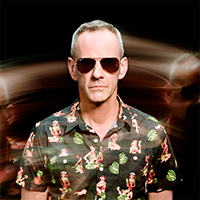
Fatboy Slim — is the stage name of British DJ, music producer and musician Norman Cook (Norman Quentin Cook), who was born Quentin Leo Cook. He was born on 31 July 1963 in Bromley, England. Fatboy Slim became one of the central figures of British big beat in the 1990s and one of the artists who helped take breakbeat-driven electronic music from club culture into the British and international charts.
Before launching the Fatboy Slim project, Cook had already played bass in The Housemartins, reached number one in the UK chart with Beats International and released music through Freak Power, Pizzaman and several other aliases. His solo discography as Fatboy Slim includes four main studio albums, among them You’ve Come a Long Way, Baby, featuring The Rockafeller Skank, Praise You and Right Here, Right Now.
Early years
Norman Cook was born on 31 July 1963 in Bromley, which at the time was part of Kent. At birth he was given the name Quentin Leo Cook. He spent his childhood and teenage years in Reigate, Surrey.
As a teenager, Cook became interested in the British punk scene, collected records and produced a fanzine called Peroxide with friends. His first attempts at making music were not as a bass player but on drums and vocals: he played in the local new wave band Disque Attack.
Even before beginning a professional career, Cook became interested in DJing and in the possibilities of combining music from different styles. His early musical reference points included punk, funk, soul, hip-hop and the emerging world of club-oriented electronic music.
Brighton and education
In 1982, Cook moved to Brighton and enrolled at Brighton Polytechnic, which later became the University of Brighton. Contrary to a frequently repeated claim, he did not study printing: Cook earned a bachelor’s degree in British Studies and graduated in 1985 with a 2:1.
The move was also important for his musical career. Cook became actively involved in Brighton’s club scene and developed his skills as a DJ. The city later became his permanent home and has remained closely connected both with the history of Fatboy Slim and with his series of major performances on Brighton Beach.
The Housemartins
In the mid-1980s, Cook joined the indie pop band The Housemartins, formed in Kingston upon Hull. He played bass, replacing original bassist Ted Key.
The Housemartins’ music was far removed from Fatboy Slim’s later electronic sound: the band combined guitar pop, indie rock and soul-influenced vocals. Their best-known songs include Happy Hour and the a cappella version of Caravan of Love.
In December 1986, Caravan of Love reached number one on the UK Singles Chart. Cook therefore appeared on a British number-one hit more than a decade before Fatboy Slim’s commercial breakthrough.
The Housemartins broke up in 1988. Vocalist Paul Heaton and drummer Dave Hemingway later formed The Beautiful South, while Cook shifted his focus fully towards DJing, electronic music and studio production.
Beats International
After The Housemartins, Cook moved towards music built around samples, club rhythms, hip-hop, reggae and soul. One of the first major projects of this period was Beats International.
In 1990, Beats International released Dub Be Good to Me featuring singer Lindy Layton. The track was constructed from several different musical sources, including the bass line from The Clash’s The Guns of Brixton and elements of The S.O.S. Band’s Just Be Good to Me.
Dub Be Good to Me topped the UK Singles Chart and remained at number one for four weeks. For Cook, the release marked his first major success as a producer of dance music.
Freak Power, Pizzaman and other projects
During the first half of the 1990s, Cook worked under several different names and did not attempt to connect all of his releases to a single artist identity.
Together with vocalist and trombonist Ashley Slater, he formed Freak Power, a project combining acid jazz, funk, soul and electronic rhythms. The song Turn On, Tune In, Cop Out was first released in 1993, and after being used in a Levi’s advertisement it was reissued and reached number three in the UK chart in 1995.
At the same time, Cook released club-oriented house music as Pizzaman. Singles associated with the project include Trippin’ on Sunshine, Sex on the Streets and Happiness. He also used the name Mighty Dub Katz and several less prominent aliases.
This way of working helped shape one of Cook’s main professional strengths: he could move freely between funk, soul, hip-hop, acid house, breakbeat and pop, treating genre boundaries as flexible rather than fixed.
The emergence of Fatboy Slim
Cook began using the name Fatboy Slim in the mid-1990s. Unlike many stage names, it was not attached to a fictional character or elaborate concept. For Cook, it was simply another project name, although it eventually became the central identity of his later career.
In 1996, Brighton label Skint Records released Fatboy Slim’s debut album Better Living Through Chemistry. The title referenced an advertising slogan used by the chemical company DuPont.
Key tracks on the album include Everybody Needs a 303, whose title refers to the Roland TB-303 bass synthesiser, and Going Out of My Head.
The album arrived during the emergence of British big beat — a club-oriented style combining heavy breakbeats, house, hip-hop-style sampling, funk and the energy of rock music. Fatboy Slim was not the sole creator of the genre: The Chemical Brothers, The Prodigy and other British artists were developing similar ideas at the same time. Cook, however, became one of the musicians who most successfully adapted the aesthetic for a mainstream audience.
Big Beat Boutique
The early Fatboy Slim period was closely associated with the Big Beat Boutique club night in Brighton. In his sets, Cook mixed house, hip-hop, breakbeat, funk and rock records, often altering their usual playback speeds and creating transitions between tracks that formally belonged to different genres.
This approach also helps explain the structure of his own productions: Fatboy Slim tracks are often built not around complex harmony but around a recognisable sample, a short vocal phrase, a breakbeat and gradual changes to a small number of rhythmic elements.
Brimful of Asha remix
Before the release of Fatboy Slim’s breakthrough album, Cook achieved another UK number one as a remixer. His version of Cornershop’s Brimful of Asha substantially increased the tempo of the original and transformed it into a dance track.
The remix was released as the main single version in 1998 and reached number one on the UK Singles Chart. It became one of the best-known examples of Cook’s ability to reconstruct another artist’s song while retaining the source material but completely changing its rhythmic function.
You’ve Come a Long Way, Baby
Fatboy Slim’s second studio album, You’ve Come a Long Way, Baby, was released in October 1998. It was this record that transformed the project from a prominent name in the British club scene into an internationally recognised act.
The album topped the UK chart and spent a total of four weeks at number one. It produced four major singles:
- The Rockafeller Skank
- Gangster Tripping
- Praise You
- Right Here, Right Now
The Rockafeller Skank is built around an intensive montage of vocal and instrumental samples and the phrase “Right about now, the funk soul brother”, which became one of the most recognisable lines in the Fatboy Slim catalogue.
Right Here, Right Now uses a gradually building structure and a repeated vocal fragment. The track later became widely used outside the club scene, including at sporting events and in television and film.
Praise You and the Spike Jonze video
The single Praise You became Fatboy Slim’s first and only solo single to reach number one on the main UK Singles Chart.
The track is based around a vocal sample from Camille Yarbrough’s Take Yo’ Praise. Cook surrounded it with a piano loop, breakbeat and additional samples, turning a relatively obscure 1970s recording into the foundation of an international dance hit.
The music video became equally famous. Spike Jonze filmed it in the style of an amateur recording of the fictional Torrance Community Dance Group performing outside a cinema in California. Jonze himself appears as the group’s leader, Richard Koufey.
In 1999, Praise You won three MTV Video Music Awards — for Breakthrough Video, Direction and Choreography. The video became one of the best-known music clips of the late 1990s.
Halfway Between the Gutter and the Stars
Fatboy Slim’s third album, Halfway Between the Gutter and the Stars, was released in 2000. By that point, big beat was already beginning to lose its position as the dominant British dance trend, and the album’s sound therefore extended beyond the earlier genre formula.
Gospel, funk and soul became more prominent, while guest vocalists included Macy Gray and Bootsy Collins.
Key tracks include Sunset (Bird of Prey), Star 69 and Weapon of Choice.
Weapon of Choice
American funk musician Bootsy Collins provided the vocals for Weapon of Choice. The song’s broader cultural profile, however, is closely associated with its music video directed by Spike Jonze.
Actor Christopher Walken stars in the video. Throughout the clip, he dances through an almost empty hotel before appearing to lift off the floor during the final section.
At the 2001 MTV Video Music Awards, the Weapon of Choice video won six awards, including prizes for Direction, Choreography, Editing and Cinematography.
In 2002, Weapon of Choice brought Fatboy Slim his only Grammy to date, in a music-video category. Across his career, he has received six Grammy nominations.
Big Beach Boutique II
The series of Fatboy Slim performances on Brighton Beach holds a special place in his career. The first Big Beach Boutique took place in 2001 and attracted around 40,000 people.
On 13 July 2002, the free Big Beach Boutique II took place. Organisers expected approximately 60,000 visitors, but around 250,000 people arrived on the seafront.
In scale, it became one of the largest events in British club culture of the early 2000s, but it also demonstrated the risks of free events of that size. Brighton’s transport system became overwhelmed, emergency services experienced serious difficulties reaching people in the crowd, and more than one hundred people were injured. Two deaths were linked to events following the concert.
Cook later said that such an event should not be repeated unless the safety of the audience could be guaranteed. Subsequent beach shows were held with controlled capacity and ticketing systems.
Palookaville
Fatboy Slim’s fourth studio album, Palookaville, was released in 2004. It remains the project’s most recent full-length solo studio album.
On the record, Cook continued moving away from a strict big beat formula, combining breakbeat and house with song-based vocals and more conventional structures.
Major singles included Slash Dot Dash, Wonderful Night featuring Lateef and The Joker. Wonderful Night and the album itself received Grammy nominations in 2006.
From studio albums to DJing
After Palookaville, Fatboy Slim stopped releasing full-length solo albums on a regular basis. This did not mean the project ended: Cook continued touring and releasing individual singles, remixes and DJ compilations.
Over time, live performances and DJing became more important to his work than the traditional “album — tour — next album” cycle.
In 2006, the retrospective compilation Why Try Harder: The Greatest Hits was released, bringing together key Fatboy Slim tracks and material from Cook’s earlier projects.
Here Lies Love with David Byrne
In 2010, Cook and Talking Heads founder David Byrne released the concept album Here Lies Love.
It is not a solo Fatboy Slim studio album and is therefore more accurately treated separately from the project’s four main studio records. Byrne and Cook built the music around disco, house and club-oriented pop.
The story centres on former Philippine first lady Imelda Marcos, her rise alongside Ferdinand Marcos and the fall of the regime following the 1986 People Power Revolution.
The project gradually moved beyond recorded music. A stage version of Here Lies Love was presented at New York’s Public Theater in 2013 and was later staged in London.
In 2023, the musical opened on Broadway. At the 2024 Tony Awards, the production received four nominations, including Best Original Score: the music was credited to David Byrne and Fatboy Slim, with lyrics by Byrne.
Eat, Sleep, Rave, Repeat
One of Cook’s major later club hits was Eat, Sleep, Rave, Repeat, created with Italian producer Riva Starr and British beatboxer Beardyman.
The Calvin Harris version became particularly widespread. In 2013, the release reached number three on the UK Singles Chart and number one on the UK Dance Chart.
The phrase “Eat, sleep, rave, repeat” quickly moved beyond the track itself and became part of 2010s club pop culture.
Back to Mine
Back to Mine: Fatboy Slim was released in November 2020. It is not a studio album but a curated DJ compilation from the established Back to Mine series.
For the compilation, Cook selected mainly funk, soul, reggae and other records connected with his personal musical tastes and sampling sources. The track list includes Camille Yarbrough’s Take Yo Praise, the recording sampled for Praise You.
Current period
Throughout the 2010s and 2020s, Fatboy Slim has remained primarily a touring DJ. Unlike the late 1990s, when his career centred on studio albums and singles, festival and club DJ sets became the main format of his work.
Cook himself has said that his interest in regularly creating new studio music has decreased in recent years, while his desire to perform and work directly with audiences from behind the decks has remained.
His sets continue to include both his own recordings and house, techno, breakbeat, disco and contemporary edits. Mash-up techniques are an important part of his performances, combining the vocal or instrumental section of one well-known track with the rhythmic foundation of another.
The return of Big Beach Boutique in 2026
In July 2026, Cook once again connected his main contemporary concert project with Brighton. Big Beach Boutique 7 took place on Brighton Beach on 16, 17, 18 and 19 July.
All four dates sold out. Artists appearing alongside Fatboy Slim across the four days included Seth Troxler, Derrick Carter, Groove Armada, Jayda G, Horse Meat Disco, HoneyLuv, TSHA and others.
Unlike the uncontrolled free event of 2002, the modern Big Beach Boutique operates as a ticketed festival with limited capacity, entry rules and a dedicated security system.
Musical style
Fatboy Slim is most commonly associated with big beat, although his musical foundation is considerably broader.
His recordings and DJ sets contain elements of:
- breakbeat
- house
- acid house
- funk
- soul
- hip-hop
- rock
- disco
- reggae
One of the defining features of Cook’s production is his use of samples. He may take a short vocal fragment, bass line, drum break or instrumental phrase from an older recording and reconstruct an entirely new track around it.
This method was already evident in Dub Be Good to Me and later became fundamental to tracks such as Praise You, The Rockafeller Skank and many Fatboy Slim remixes.
Fatboy Slim and big beat
It would be inaccurate to describe Fatboy Slim as the sole creator of big beat. The genre developed in Britain during the first half of the 1990s across several parallel club scenes.
Its principal representatives are usually considered to include Fatboy Slim, The Chemical Brothers, The Prodigy and other artists who used heavy breakbeats together with elements of rock, funk and hip-hop aesthetics.
Cook’s role lies primarily in popularising this approach. You’ve Come a Long Way, Baby, the videos for Praise You and Weapon of Choice, and large-scale DJ performances helped move music rooted in club culture into the mainstream pop landscape of the late 1990s and early 2000s.
Music videos
The visual side of Fatboy Slim’s career occupies an unusually important place in his history. Cook himself, however, is not always the central figure in his videos.
Particularly well-known examples include:
- Praise You — Spike Jonze and the Torrance Community Dance Group
- Weapon of Choice — Spike Jonze and Christopher Walken
- Right Here, Right Now — an animated depiction of the evolution of life
- Gangster Tripping — a video built around the progressive destruction and explosion of household objects
Two videos — Praise You and Weapon of Choice — won a combined nine MTV Video Music Awards: three in 1999 and six in 2001.
Awards and professional recognition
Fatboy Slim has won one Grammy from six nominations. The award came for the Weapon of Choice video in 2002.
At the BRIT Awards, he won Best British Dance Act twice — in 1999 and 2001. The frequently repeated claim that he also won the category in 2002 is incorrect: Basement Jaxx received the award that year.
In 2007, Norman Cook received the Ivor Novello Award for Outstanding Contribution to British Music.
In 2015, the University of Brighton presented its former student with an Alumnus Award for his contribution to the music industry and support for the university.
Main Fatboy Slim studio albums
Better Living Through Chemistry — 1996
Fatboy Slim’s debut album and one of the early records from the formative period of British big beat. Key tracks include Everybody Needs a 303 and Going Out of My Head.
You’ve Come a Long Way, Baby — 1998
The project’s main commercial breakthrough. The album reached number one in the UK and includes The Rockafeller Skank, Gangster Tripping, Praise You and Right Here, Right Now.
Halfway Between the Gutter and the Stars — 2000
The album expanded the big beat sound towards funk, soul and gospel. Major tracks include Weapon of Choice, Star 69 and Sunset (Bird of Prey).
Palookaville — 2004
Fatboy Slim’s fourth and, to date, most recent solo studio album. It includes Slash Dot Dash, Wonderful Night and The Joker.
Other important releases
Here Lies Love (2010) should be regarded as a collaborative concept album by David Byrne & Fatboy Slim, rather than as Fatboy Slim’s fifth solo studio album.
Back to Mine: Fatboy Slim (2020) is a DJ compilation.
Beyond albums, Cook’s catalogue also includes important standalone singles, remixes and recordings from earlier projects — from Beats International and Freak Power to Eat, Sleep, Rave, Repeat.
Selected tracks
- Everybody Needs a 303
- Going Out of My Head
- The Rockafeller Skank
- Gangster Tripping
- Praise You
- Right Here, Right Now
- Sunset (Bird of Prey)
- Star 69
- Weapon of Choice
- Wonderful Night
- Eat, Sleep, Rave, Repeat
Personal life
Norman Cook was married to British television and radio presenter Zoë Ball. They married in 1999, announced their separation in 2016 and finalised their divorce in 2020. The former couple have two children — a son, Woody, and a daughter, Nelly.
Cook continues to live in Brighton, a city with which he has been closely connected since the early 1980s and which holds a special place in his professional biography.
Fatboy Slim’s significance
Fatboy Slim occupies an important place in the history of British electronic music because of the unusual way his career connects club culture with the mainstream. His career began long before the Fatboy Slim name itself appeared: The Housemartins gave him experience in a successful guitar band, Beats International brought his first number-one hit as a producer, and the numerous projects of the first half of the 1990s allowed him to develop his sampling and club-production techniques.
As Fatboy Slim, Cook became one of the most successful representatives of big beat. His importance lies not in having “invented” the genre single-handedly, but in helping make breakbeat-, sample-, house- and funk-based electronic music part of mainstream popular culture.
You’ve Come a Long Way, Baby, Praise You, Right Here, Right Now and Weapon of Choice established this model in the late 1990s and early 2000s, while his long-running DJ career allowed Fatboy Slim to retain a live audience far beyond big beat’s original period of peak popularity.
In Cook’s current work, the main emphasis has shifted from studio albums to DJing. The four sold-out nights of Big Beach Boutique 7 on Brighton Beach in July 2026 continued a story that has connected Fatboy Slim with the city for more than four decades.