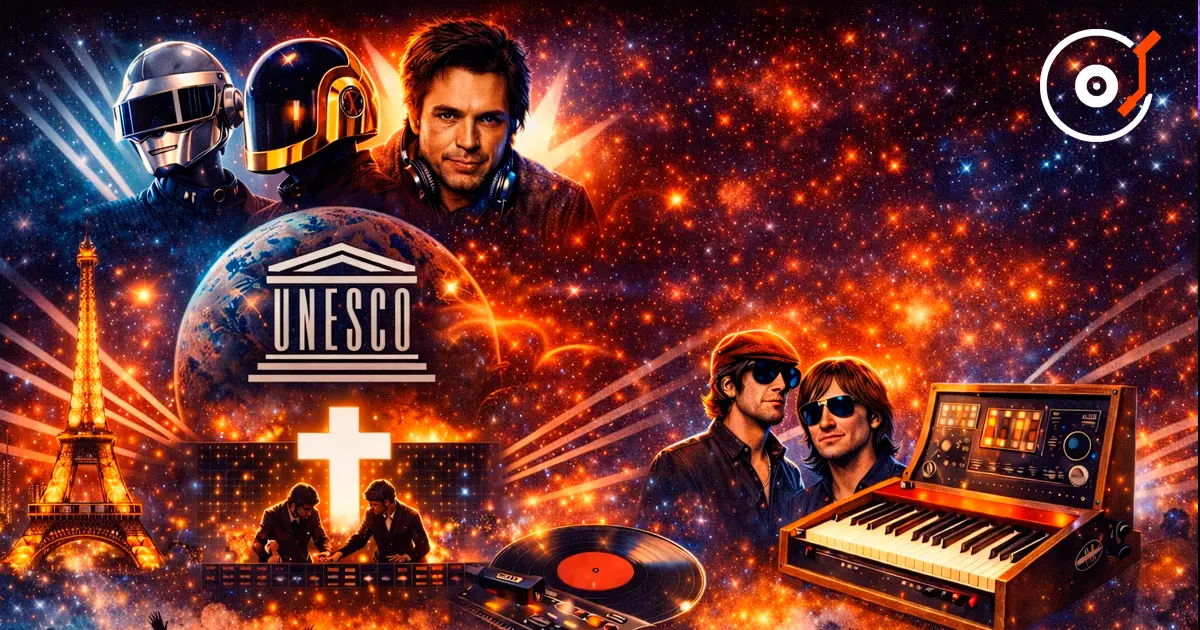
Why was French electronic music recognized as UNESCO World Heritage? The history of French Touch: from Daft Punk and Cassius to Jean-Michel Jarre and Maurice Martenot.
French house music, known worldwide as French Touch or French House, has officially been recognized by UNESCO as Intangible Cultural Heritage of Humanity. This decision закрепляет the genre’s status not merely as a musical style, but as a full-fledged cultural phenomenon that shaped France’s modern identity and had a profound impact on the global electronic music scene.
What French House and French Touch Are
French House is a subgenre of house music that emerged in France in the early 1990s. Its defining features include heavy use of samples from 1970s–1980s disco, funk, and soul, dense “filtered” basslines, compression with a characteristic pumping effect (sidechain compression), and a strong dancefloor energy.
Over time, the term French Touch came to describe not only a sound, but an entire philosophy of production: refined, stylish, slightly retro-futuristic, with a focus on atmosphere and groove rather than aggressive drops. This approach made French electronic music instantly recognizable from the very first seconds.
Artists Who Shaped the Genre
The face of French Touch includes artists such as Daft Punk, Cassius, Air, and Justice. Each expanded the genre in their own way—from soft, almost pop-oriented house to aggressive electro-disco with rock aesthetics.
A special place in this history belongs to Jean-Michel Jarre, a figure who bridged academic electronic music and club culture. His experiments with synthesizers, spatial sound, and large-scale live shows laid the foundation upon which an entire generation of French House producers later emerged.
Historical Roots of French Electronic Music
France embraced electronic music long before the rise of club culture. As early as the first half of the 20th century, French composers and engineers were actively experimenting with sound, and in 1928 Maurice Martenot introduced the Ondes Martenot—one of the first electronic instruments in history.
This tradition of experimentation, blending science, art, and technology, later naturally transitioned into electronic dance music, where French producers once again found themselves at the forefront.
Impact on the Global Scene
French House has had an enormous influence on the development of house music in the United States, the United Kingdom, and beyond. Its elements can be heard in modern EDM, nu-disco, indie dance, and even pop music. Many techniques now considered standard—filtered samples, “breathing” compression, retro aesthetics—were popularized on a massive scale by French artists.
Beyond clubs, French Touch entered fashion, advertising, cinema, and video games, becoming part of global pop culture. French electronic music came to be associated with elegance, minimalism, and technological avant-gardism—qualities now perceived as a cultural brand of France.
Cultural-Level Recognition
The recognition of French Touch as Intangible Cultural Heritage by UNESCO underscores that electronic music is no longer viewed as a temporary or “secondary” phenomenon. On the contrary, it is acknowledged as an essential part of cultural history, alongside classical music, painting, and architecture.
For the global electronic scene, this is a precedent—a rare case where a club genre receives official recognition as humanity’s cultural heritage. For France, it is confirmation that its contribution to modern music extends far beyond the national scene and continues to shape the sound of the 21st century.