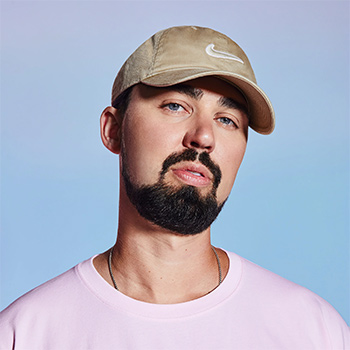
Sonny Fodera is an Australian DJ and producer from Adelaide and one of the most prominent figures on the contemporary house scene. Born on November 10, 1985, he later moved to the United Kingdom and settled in London. His music has evolved from jackin house, deep house and tech house toward melodic vocal house, where club grooves intersect with UK garage, pop-oriented structures and large vocal performances. Fodera has released music on Cajual Records, Defected and his own label Solotoko, and has collaborated with MK, Diplo, D.O.D, Jazzy, Clementine Douglas, Ella Eyre, Vintage Culture and other artists. In 2026, he entered the DJ Mag Top 100 DJs for the first time, reaching No. 80.
Early years
Sonny Fodera grew up in Adelaide. Before electronic music, he played bass guitar and electric guitar, performed in garage bands and was interested in hip-hop.
At around fifteen or sixteen, Sonny began making beats on his own using Cool Edit Pro and FruityLoops. Among his early musical influences were Nas, A Tribe Called Quest, De La Soul and other representatives of American hip-hop.
A turning point came when he discovered house music. At the Electric Circus club in Adelaide, Fodera heard a set by American DJ Derrick Carter. He was particularly drawn to the combination of house groove, jazz elements and rhythms that felt close to hip-hop.
After that, electronic club music gradually became his main direction. Sonny started buying vinyl, practising with friends and studying the American house scene. Derrick Carter, Inland Knights and producers associated with the Chicago school were among his important early reference points.
First releases and the American house scene
By the end of the 2000s, Fodera was already regularly releasing music on independent house labels including Guesthouse, Drop Music, Salted and Nervous Records.
An important connection was Chicago producer Gene Farris, who invited Sonny to remix Dance Warriors. Through that relationship, Fodera moved closer to the circle around Cajual Records, the label founded by Green Velvet, who had previously been widely known under the alias Cajmere.
In the early 2010s, his touring territory expanded rapidly. Fodera travelled regularly to the United States and Europe, spent the summer of 2010 in Ibiza, lived for a period in Melbourne and then began spending more and more time in Europe.
Moving Forward
On February 25, 2013, Cajual Records released his debut studio album Moving Forward.
The record preserved the character of early Sonny Fodera: warm house grooves, funk and soul, elements of jackin house and relatively concise club arrangements. Gene Farris, Cajmere, Russoul and Walter Phillips contributed to the album.
This period was closely connected with the American house tradition. Fodera’s music had not yet developed the pronounced pop structures of his later years, but two characteristics that would remain throughout his career were already clearly audible: close attention to the bassline and a determination to make groove the central driving force of a track.
That same year, Mixmag included him among its Hot Six, highlighting him as one of the rapidly rising house producers.
After Parties & Aeroplanes
In 2014, Cajual released his second album, After Parties & Aeroplanes.
The title reflected a changing lifestyle: constant flights, performances and club nights had already become a normal part of the profession.
The music was still rooted in house, but its scope had widened. Larger basslines, a more noticeable tech house component and more vocals were added to the jackin and deep house grooves.
These changes gradually moved Fodera beyond the relatively narrow American jackin house scene and brought him closer to a broader European club audience.
Defected and Frequently Flying
The next major stage of his career was linked to Defected Records.
Sonny began appearing regularly at Defected events, and in early 2016 he compiled his own edition of the Defected In The House series. That summer, BBC Radio 1 invited him to record his first Essential Mix.
In November 2016, his third studio album Frequently Flying was released.
Compared with his first records, it relied much more heavily on vocals. Tracks were increasingly designed not only as tools for DJ sets, but also as standalone songs with a clearly defined melodic centre.
It was during this period that the approach later associated most strongly with Sonny Fodera began to take shape: the house rhythm remained the club foundation, while vocals and melody gained almost equal importance.
Solotoko
In 2018, Sonny Fodera launched his own label Solotoko.
Earlier in his career he had already operated his own imprint, Beatdown Music, but Solotoko emerged under very different professional circumstances, when Fodera already had an international audience and could use the label not only for his own releases but also to support other producers.
The Solotoko catalogue went on to feature OFFAIAH, Biscits, Yolanda Be Cool and other artists from the contemporary house scene.
Biscits is a particularly telling example: Fodera’s support and the release of his material through Solotoko became one of the important early stages of his international career.
Rise
On July 12, 2019, Sonny Fodera released his fourth studio album Rise, his first full-length release on his own Solotoko label.
The sound of the album moved noticeably closer to the modern British house scene. Deep house and tech house still formed its foundation, but vocal performances and more accessible song structures became significantly more important.
Rise marked the transition from a predominantly club-focused discography to a format in which the music could work equally well in a DJ set, at a festival and outside the dancefloor.
One Night and the collaboration with MK
One of Sonny Fodera’s key creative partners became American house producer MK (Marc Kinchen).
In 2019, they released One Night featuring Raphaella. The track combined MK’s characteristic approach to vocals and chords with Fodera’s dense bass foundation.
The collaboration proved long-lasting. Several years later they reunited for Asking, while the influence of classic vocal house became increasingly apparent in Sonny’s own work.
Turn Back Time with Diplo
In 2020, Fodera recorded Turn Back Time with Diplo.
The track is built around a powerful bass riff, a straight house beat and a short vocal hook. It became one of the standout releases in the period leading up to his fifth album and showcased a harder club-oriented side of Fodera.
Wide Awake
On October 22, 2021, his fifth studio album Wide Awake was released.
A significant part of the record was created during the COVID-19 pandemic. The absence of constant touring gave Sonny far more time in the studio and allowed him to work consistently on a full-length album.
The release contains 14 tracks. Featured artists include Ella Eyre, Sinead Harnett, MK, Diplo, Camden Cox, Vintage Culture and Raphaella.
Wide Awake firmly established the modern Sonny Fodera formula: emotional vocal house designed to work simultaneously in clubs, at festivals and as standalone listening.
Tracks such as Nah, Turn Back Time, One Night, Wired and the title track Wide Awake demonstrate a range extending from direct house to UK garage and softer electronic pop.
Ibiza and Gorgon City
Ibiza has occupied a special place in Sonny Fodera’s career since the early 2010s. His first seasons on the island came when he was only beginning to tour internationally, but over time Fodera became a regular presence in some of its largest club programmes.
In 2022, he joined forces with Gorgon City for an extended joint residency at Amnesia Ibiza. The partnership reflected the musical development of both projects particularly well, with vocal house, club house and British dance aesthetics serving as a natural point of overlap.
Fodera later secured major programmes of his own on the island, including a residency at Pacha.
Asking
In July 2023, Sonny Fodera released Asking, recorded with MK and British vocalist Clementine Douglas.
The track became one of the most successful examples of his mature vocal house sound. The club rhythm is almost entirely subordinated to melody and voice, while the low-frequency foundation keeps the track powerful enough for large dancefloors.
Asking continued Fodera’s long-running collaboration with MK and marked the beginning of a particularly productive period in which several consecutive vocal singles reached large international audiences.
Mind Still
In spring 2024, Sonny Fodera released Mind Still featuring British vocalist blythe.
Compared with several other vocal tracks from this period, the production is noticeably harder: a dense bassline and tense synth part bring the music closer to peak-time club territory.
At the same time, the vocal remains central to the arrangement, clearly illustrating the character of Fodera’s mature sound: heavier production does not require abandoning song form.
Somedays
In July 2024, Somedays was released, created together with British producer D.O.D and Irish singer Jazzy.
The track became one of Sonny Fodera’s biggest international successes, combining his vocal house approach with D.O.D’s more forceful club production and Jazzy’s instantly recognisable vocal style.
Somedays received a nomination at the BRIT Awards 2025 in the Song of the Year category.
For Fodera, it marked an important point in a long evolution from a specialist house scene toward music capable of existing simultaneously in club sets and major national charts.
Tell Me and the APRA Music Awards
On February 7, 2025, Sonny Fodera released Tell Me, recorded with Clementine Douglas.
The track centres on an emotional vocal performance supported by a dense but relatively smooth house groove. By this point, the defining model of Fodera’s mature period was almost fully established: a song structure that never sacrifices the physical club foundation.
In 2026, Tell Me won an APRA Music Award in the category Most Performed Dance/Electronic Work.
All This Time and new collaborations
In 2025, Sonny reunited with Jazzy for the track All This Time.
A remix was later produced by Armand Van Helden, one of the most influential American house producers of the 1990s and 2000s.
Symbolically, this connection ties together different stages of Fodera’s career particularly well: an artist who began under the strong influence of American house eventually found himself working within the same professional space as producers from the generation whose music helped shape his own style.
can we do it all again?
On June 12, 2026, Sonny Fodera released his sixth studio album can we do it all again? through his own label Solotoko.
The record contains 18 tracks and runs for around an hour. Fodera himself described it as a musical reflection on roughly five years of life and touring.
The album is conceived almost like a long DJ set: its mood gradually moves from more accessible vocal house toward deep house, tech house, afro house and harder club passages.
The tracklist includes previously released tracks such as Asking, Mind Still, Somedays, Tell Me and All This Time, alongside a substantial amount of new material.
Featured artists include CHRYSTAL, Sienna Sophia, Libianca, D.O.D, Poppy Baskcomb, Takura, Gia Koka, Jazzy, HAYLA, Clementine Douglas, MK, Lilly Ahlberg, Hayley May, Julia Church, Caroline Byrne, James Carter and Elsie.
can we do it all again? became the most complete representation of Fodera’s mature period. At this stage, his early interest in groove can no longer be separated from song-based production: almost every track is built around a strong vocal or melodic idea while retaining the functionality of club music.
DJ Mag Top 100 DJs
In 2026, Sonny Fodera entered the DJ Mag Top 100 DJs for the first time, reaching No. 80.
For the artist, it was a relatively late debut: by the time he entered the ranking, his professional career had already lasted almost two decades.
DJ Mag described Fodera’s style as groove-driven, emotive and vocal-led house music and highlighted Somedays as one of his best-known recent tracks.
During the same period, Fodera headlined Creamfields, held a residency at Pacha Ibiza and continued extensive international touring.
His debut in the Top 100 DJs is particularly interesting in the context of the length of his career: Sonny is not an artist whose international profile emerged around a single unexpected hit. By this point, he already had six studio albums, his own label, years of Ibiza residencies and collaborations with several generations of house musicians.
Musical style
House has remained the foundation of Sonny Fodera’s music throughout his career, although his interpretation of the genre has changed considerably.
His early releases are associated with jackin house, funky house and deep house. Swing, short samples, basslines and the influence of the Chicago school play a central role.
During the second half of the 2010s, the influence of tech house became stronger, while the arrangements grew larger and better suited to festival settings.
Beginning with Rise, and especially with Wide Awake, vocals increasingly became the central element.
Sonny Fodera’s mature tracks are often structured almost like pop songs: they feature a clearly defined vocal theme, an emotional chorus and a compact arrangement. Yet the rhythmic foundation remains house — a straight beat, powerful bass and a groove designed for the dancefloor.
This is precisely what allows his music to exist in several spaces at once. Somedays, Tell Me and Asking work as standalone songs while retaining enough club energy for large DJ sets.
Production approach
Fodera began making music before starting his professional DJ career. As a teenager, he created his first beats in simple software before gradually moving toward a full studio setup.
His early hip-hop experience left a noticeable mark. Sonny became accustomed to thinking in terms of short samples, repetition and groove, and those skills transferred naturally when he moved into house music.
He pays particular attention to the bassline. Even in his most melodic and vocal-driven tracks, the low end remains powerful enough for the music to retain its physical impact on a club sound system.
Another important characteristic is his work with vocalists. Fodera rarely uses the human voice merely as a short decorative sample: the vocal line usually becomes a fully developed part of the composition and, in many of his modern tracks, determines the entire arrangement.
Solotoko as an independent label
As Sonny Fodera’s career grew, his own Solotoko evolved from an artist imprint into an independent house platform.
The label allowed Fodera to maintain control over his own releases while also supporting a new generation of producers. Its catalogue has featured artists whose music sits between house, tech house and harder club styles.
It is particularly significant that his sixth album, can we do it all again?, was also released through Solotoko. In this way, the label developed from a platform for individual club releases into the home of one of the most ambitious projects in Fodera’s discography.
Discography
Studio albums
- Moving Forward — 2013
- After Parties & Aeroplanes — 2014
- Frequently Flying — 2016
- Rise — 2019
- Wide Awake — 2021
- can we do it all again? — 2026
Selected singles and tracks
- One Night — with MK featuring Raphaella
- Turn Back Time — with Diplo
- Nah — featuring Sinead Harnett
- Wired — featuring Ella Eyre
- Asking — with MK featuring Clementine Douglas
- Mind Still — featuring blythe
- Somedays — with D.O.D and Jazzy
- Tell Me — with Clementine Douglas
- All This Time — with Jazzy
- My Loving — with CHRYSTAL
- Let Me Be In Your Arms — with Libianca
- Think About Us — with D.O.D featuring Poppy Baskcomb
- Only Thing That Matters — with HAYLA
Sonny Fodera has travelled from Adelaide’s small house scene and early jackin house releases to international festivals, a long-running connection with Ibiza, his own label and vocal hits that reached far beyond club audiences. Yet the foundation of his music has remained recognisable throughout: groove is still the central element. The tempo, scale of the arrangements and role of vocals have changed, but it is the combination of emotional songwriting with a physically powerful house rhythm that has made Sonny Fodera one of the most consistent and recognisable artists on the contemporary house scene.