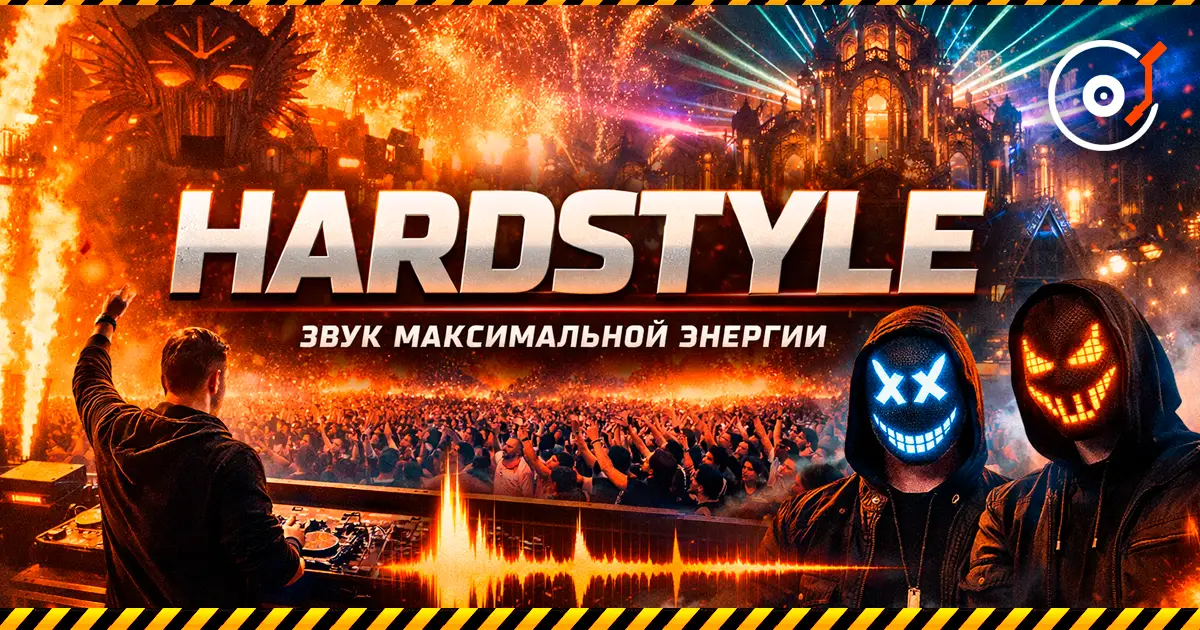
Hardstyle is one of the hardest genres of electronic music. History, subgenres, iconic artists, and festivals. Everything you need to know.
Hardstyle is one of the most powerful and emotionally charged genres of electronic dance music, combining the aggression of hardcore, the structure of techno, and the epic nature of trance melodies. It emerged in the early 2000s in the Netherlands and, over two decades, evolved into a global movement with its own culture, festivals, and a fiercely loyal audience.
Today, hardstyle is no longer just a club genre, but a massive festival phenomenon capable of gathering tens of thousands of fans worldwide.
Origins and Evolution of the Genre
Hardstyle formed at the intersection of hard trance, hard house, and hardcore. A key turning point was the rethinking of the hard beat: producers began experimenting with the kick drum shape—stretching it, adding distortion, and creating the signature “reversed” punch.
The Netherlands are considered the birthplace of the genre, where hardstyle quickly became an alternative to more commercial trance and techno. Soon, the scene expanded beyond Europe and firmly established itself in Australia, the United States, and Latin America.
Key Characteristics of Hardstyle
1. The kick drum as the foundation of the sound
Hardstyle is impossible to confuse with any other genre due to its signature kick — hard, distorted, with a long sustain and a sharp attack. It is the kick that creates the physical sensation of the music.
2. High tempo
The standard range is 150–155 BPM, making tracks dynamic and aggressive, perfectly suited for rave environments.
3. Contrasting structure
A typical hardstyle track is built around sharp transitions:
- atmospheric or melodic intro
- a break with vocals or a synth line
- a powerful drop dominated by the kick
4. Epic melodies and vocals
Unlike hardcore, hardstyle actively uses harmonies, choirs, orchestral elements, and vocal parts, creating a sense of drama and uplift.
Hardstyle Subgenres
The genre has long ceased to be monolithic and has split into several directions:
- Euphoric Hardstyle — melodic and emotional, with bright leads and vocals
- Rawstyle — darker and more aggressive, with heavy kicks and minimalism
- Xtra-Raw — an extremely hard form of rawstyle
- Hardstyle Classics — the mid-2000s sound with simpler, “dirtier” kicks
Each subgenre has its own audience and mood — from uplifting to openly industrial.
Festival Culture
Hardstyle is inseparable from large-scale festivals, where music transforms into massive shows of light, pyrotechnics, and visual concepts.
Iconic events of the genre include:
- Defqon.1 — the largest hard-scene festival in the world
- Qlimax — a legendary nighttime show with a strong conceptual focus
- Decibel Outdoor — a major open-air hard-scene festival in the Netherlands
For hardstyle fans, a festival is a ritual rather than just a concert.
Iconic Hardstyle Artists and Their Influence
Headhunterz
Headhunterz is a key figure in the history of hardstyle, the artist who took the genre beyond the underground. In the late 2000s, he shaped the sound of euphoric hardstyle, making melody and emotional uplift central elements of the track.
His influence:
- established the “melodic break → powerful drop” format
- brought audiences from trance and EDM into hardstyle
- proved that hard music can be massive and emotional
Headhunterz became a symbol of the era when hardstyle stopped being niche and turned into festival mainstream.
Noisecontrollers
Noisecontrollers are the architects of the technical and production standard of hardstyle. Their tracks have always stood out for clean mixes, complex structures, and an engineering approach to sound.
Their influence:
- raised the bar for sound design and arrangement
- laid the foundations of “intelligent” hardstyle
- influenced a new generation of producers who value detail as much as energy
Noisecontrollers made hardstyle a professional genre in studio terms.
Wildstylez
Wildstylez is a master of anthems and festival dramaturgy. His music is always built around crowd unity, emotional uplift, and the power of the “moment.”
His influence:
- defined the canon of festival anthems
- strengthened the role of vocals and choral elements
- turned hardstyle into a genre of collective experience
Wildstylez showed that hardstyle is not only aggression, but also emotional unity for thousands of people.
Sub Zero Project
Sub Zero Project represent the new school that radically refreshed the rawstyle sound. They broke classic structures and introduced industrial sound design and experimental rhythm into hardstyle.
Their influence:
- popularization of raw and xtra-raw formats
- introduction of unconventional drops and “anti-structures”
- shifting the genre toward brutality and unpredictability
Sub Zero Project became the voice of a generation for whom hardstyle is extreme and challenging, not comfortable.
Together, these artists formed a multi-layered hardstyle ecosystem — from melodic and epic to dark, aggressive, and experimental.
Thanks to them, hardstyle did not freeze in a single form but continues to evolve while preserving a recognizable identity.
Hardstyle Today
Modern hardstyle continues to evolve rapidly:
- production has become cleaner and more technological
- the role of cinematic intros and storytelling has increased
- the genre increasingly intersects with EDM, techno, and even pop elements
At the same time, hardstyle remains music of maximum energy, designed not for background listening but for full immersion.
Who This Genre Is For
Hardstyle is chosen by those who:
- seek a powerful adrenaline rush
- love festival atmospheres and rave culture
- appreciate the combination of brutality and melodic epicness
This is music for large spaces, intense emotions, and collective catharsis.
Interesting Facts About Hardstyle
The kick is more important than the melody
In hardstyle, the kick is considered the main “instrument.” Many producers start a track by designing the kick, sometimes spending more time on it than on the entire rest of the arrangement.
Psychoacoustics instead of loudness
Hardstyle sounds “louder” than most genres even at the same LUFS level. This is a psychoacoustic effect: rich harmonics of the kick and sub create a feeling of physical pressure rather than simple volume.
The “reversed” bass as a genre signature
The signature reverse bass emerged from early-2000s experiments with compression and distortion. Originally a side effect, it later became a stylistic standard.
BPM is higher than it seems
Although hardstyle nominally runs at 150 BPM, due to double and triple rhythmic divisions it often feels like 300 BPM — which is why dancing on the hard scene looks so energetic and aggressive.
Vocals with philosophy
Hardstyle often uses not just vocal hooks but motivational or existential lyrics about strength, freedom, inner struggle, and crowd unity. This brings the genre closer to anthems and manifestos.
A genre born in “bedroom” studios
Many hardstyle pioneers started literally in bedrooms, using minimal setups and cheap VST plugins. That is why the genre has always valued ideas and energy over polish.
Australia — the second capital of hardstyle
After the Netherlands, Australia became one of the main centers of hardstyle culture. The genre received mass support there as early as the mid-2000s and remains part of mainstream festivals today.
Festivals as ritual
For hardstyle fans, festivals are not just parties. Many perceive them as a ritual of cleansing and reset, where music, light, and the crowd create a collective emotional peak.
Hardstyle is rarely “background music”
Unlike house or techno, hardstyle is rarely used as background sound. It is a genre that demands attention, volume, and physical presence — either in headphones or on the dance floor.
Conclusion
Hardstyle is a genre that does not try to be comfortable. It pushes, inspires, unites, and demands full commitment from the listener. That is why it has remained one of the most resilient and devoted scenes in electronic music for over 20 years.
If electronic music is energy, then hardstyle is its extreme form.