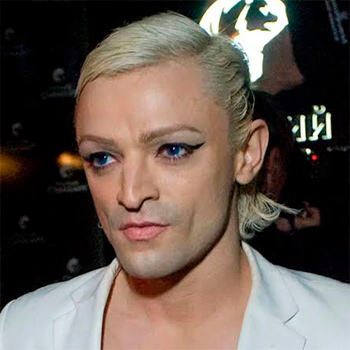
Oskar is the stage name under which singer, songwriter, and producer Scarlett la Queen rose to fame in the early 2000s. At birth, the artist was given the name Shamil Vladimirovich Malkanduyev. She was born on January 15, 1979, in Nalchik, received a law degree, and later moved to Moscow, where she became one of the most unusual figures on the Russian pop scene at the turn of the millennium. The defining songs of the Oskar period included “Mezhdu mnoy i toboy,” “Beg po ostriyu nozha,” “Mazh vazelinom,” “Panoptikum,” “Volki,” and “Detka.”
Oskar’s story differs significantly from the typical biographies of pop performers of that era. It brought together a provocative stage persona, club electronica, alternative rock, conflict with the producer system, emigration to the United States, English-language projects, and the artist’s later public identification as a transgender woman. In 2020, she began performing under the name Scarlett la Queen, effectively bringing several distinct musical periods together within a single creative biography.
Childhood in Nalchik and Yakutia
Shamil Malkanduyev was born in Nalchik, the capital of Kabardino-Balkaria, into a military family. The artist is of Balkar heritage. She spent part of her childhood in Yakutia, where the family moved because of her father’s military service, before returning to the North Caucasus.
After finishing school, Malkanduyev enrolled in the law faculty of the Kabardino-Balkarian State University named after H. M. Berbekov. A legal career, however, did not become her main professional path. Her interest in music, performance, and self-expression proved stronger, and in the late 1990s the future star moved to Moscow.
An important connection made before the Moscow period was her meeting with Artur Atsalamov, founder of the band Mertvye Delfiny. He wrote several songs that defined Oskar’s early repertoire: “Beg po ostriyu nozha,” “Mazh vazelinom,” “Panoptikum,” “Smekh ili plach,” “Bitoe steklo,” and “Rozovye devochki.” Malkanduyev also wrote part of the material herself, including “Mezhdu mnoy i toboy,” “Volki,” “Poroshok,” and “Hey.”
Moving to Moscow and Meeting Sergey Izotov
In Moscow, the aspiring performer appeared in clubs and gradually entered circles connected with the music industry. It was within the club scene that she met producer Sergey Izotov, after which work on the Oskar project began.
A carefully constructed image was created for the artist: a mysterious person existing outside familiar social and gender boundaries. Oskar appeared with artificial scars, black nail polish, skirts, leather costumes, and theatrical outfits. In the late 1990s, this aesthetic sharply contrasted with the mainstream Russian pop scene, which was dominated either by romantic singers or conventional dance projects.
The production team also circulated a fictional origin story for Oskar. According to the legend, the future singer had supposedly been trapped beneath an avalanche, spent many years in a coma, and began singing after waking up. The artist later explained that the story had been partly inspired by real accounts of her childhood in Yakutia and her father’s military service, while its dramatic elements had been invented for promotional purposes.
This method was characteristic of the 1990s entertainment industry: audiences were offered not only songs, but also a complete myth about a performer’s origins. In Oskar’s case, however, the legend became so vivid that it temporarily overshadowed the real personality of the songwriter.
Early Music Videos and Provocative Aesthetics
One of Oskar’s earliest releases was “Mazh vazelinom”, whose music video appeared in 1999. The song combined an electronic beat, alternative imagery, and deliberately provocative lyrics. The visuals were built around grotesque elements, artificial scars, and an almost horror-like treatment of the body.
The videos for “Beg po ostriyu nozha” and “Panoptikum” followed. Early Oskar was perceived not simply as a singer, but as a complete audiovisual project. The image existed at the intersection of club fashion, glam rock, androgynous aesthetics, gothic imagery, and post-Soviet pop art.
This presentation generated both fascination and rejection. Music journalists noted that the artist deliberately addressed subjects usually avoided by the Russian pop industry: the body, sexual ambiguity, inner disintegration, addiction, loneliness, and alienation. InterMedia’s review of the debut album also emphasized that Oskar had written part of the repertoire herself and that the vivid arrangements helped the project move beyond the nightclub circuit.
“Mezhdu mnoy i toboy”: Oskar’s Biggest Hit
The true mainstream breakthrough came with the release of “Mezhdu mnoy i toboy” (“Between You and Me”). The song appeared on the debut album in 2000 and became the defining work of Oskar’s career. Even decades later, it remains the artist’s most recognizable recording and the only track presented separately in Oskar’s catalog on the Russkoye Radio website.
The composition was markedly different from the provocative “Mazh vazelinom.” It was a melancholic electronic ballad with a minimalist arrangement, sustained vocals, and the chorus:
“Between you and me, only the wind remains…”
The meaning of the song allows for several interpretations. On the surface, it is a story about separation and emotional distance between two people. The dark music video, however, broadened its meaning, turning the composition into a reflection on love, betrayal, death, and the impossibility of recovering the past.
The video was directed by Alexander Igudin, with Maxim Osadchy and Alexey Tikhonov serving as cinematographers. Oskar herself participated in shaping the screenplay and visual concept. A leather skirt resembling a kilt became one of the video’s defining elements and one of the most discussed stage costumes in Russian pop culture of the early 2000s.
The video portrayed a love triangle and deliberately disrupted the conventional gender and romantic clichés of mainstream entertainment. As a result, “Mezhdu mnoy i toboy” was perceived not only as a radio ballad, but also as an independent visual work.
The song is often mistakenly described as a winner of the Golden Gramophone award. Oskar, however, is absent from the published list of winners for the 2001 ceremony. In an encyclopedic article, it is therefore more accurate to speak of the song’s major radio popularity, its place in the musical agenda, and a possible nomination, rather than a confirmed award victory.
The Album Beg po ostriyu nozha
The debut album Beg po ostriyu nozha (“Running Along the Knife’s Edge”) was released in August 2000 by Nox Music. The record combined pop music, electronic production, alternative rock, and club-oriented arrangements.
The album included:
- “Beg po ostriyu nozha”;
- “Mezhdu mnoy i toboy”;
- “Volki”;
- “Mazh vazelinom”;
- “Smekh ili plach”;
- “Poroshok”;
- “Bitoe steklo”;
- “Rozovye devochki”;
- “Panoptikum”;
- “Hey.”
The material was created with the participation of Artur Atsalamov, Evgeny Arsentyev, and Yuri Usachev. Atsalamov was responsible for the more rock-oriented and grotesque compositions, while Malkanduyev’s own songs were more often characterized by melancholy, romantic anxiety, and inward-looking confession.
Musically, the debut can be divided into two directions. The first was provocative electronic pop with industrial and alternative elements, represented by “Mazh vazelinom,” “Poroshok,” and “Panoptikum.” The second consisted of atmospheric, melodic songs, including “Mezhdu mnoy i toboy” and “Volki.”
This combination allowed Oskar to exist simultaneously within the club scene, music television, and mainstream radio. The project was unusual enough to attract a young audience, yet it also possessed memorable melodies capable of working independently of the provocative stage persona.
Oskar II and the Song “Detka”
In March 2001, the album Oskar II was released by CD Land. In essence, it was a remix project containing new versions of material from the debut record as well as the song “Detka”.
“Detka” continued the mystical direction of Oskar’s work. The song told the story of a girl resembling a doll or puppet controlled by an invisible force. It was written by Artur Atsalamov, while the arrangement was created by Evgeny Arsentyev.
The remixes were produced by Yuri Usachev, DJ Primat, Pasta, Triplex member Andrey Ivanov, DJ Shuri, Sergey Fisun, and Tom Chaos. This list reflected the close connection between the Oskar project and the Russian electronic and club scene of the early 2000s.
The same year also saw the release of Posledniy albom (“The Last Album”), which included the new songs “Voyna,” “Pyatyy ugol,” “Gde menya…,” “Osvobozhday,” “Snova i snova,” “Krylya,” and “Dusha,” as well as several remixes and the song “Detka.”
Conflict with the Producer and Loss of the Stage Name
At the height of Oskar’s popularity, relations between the artist and Sergey Izotov deteriorated sharply. Malkanduyev said that she had initially regarded the producer as a close person and mentor, but eventually felt that her identity and creativity were being used primarily as a commercial product.
The conflict concerned not only money and creative decisions, but also the rights to the stage name. According to reports from that period, the name Oskar was controlled by the production side, which meant that after the split the artist was temporarily unable to continue performing under the name that had made her famous.
Malkanduyev began publicly using her real name, Shamil, and rejected the legend created by the producer. In a 2002 interview, the artist spoke openly about her Balkar background, life in Yakutia, religious upbringing, and the conflict between personal freedom and the traditional culture of the Caucasus.
Musically, she planned to move away from commercial pop electronica toward a heavier sound with guitar riffs and social and religious themes. Under the name Shamil, however, she was unable to repeat the mainstream success of “Mezhdu mnoy i toboy.”
Moving to the United States
In 2003, the artist moved to New York. There, Malkanduyev studied at film school, continued writing music, and created the English-language project The Oskar & Psycholovers. A temporary return to Russia followed in 2008, although the United States later once again became her principal place of residence and creative activity.
The American period was important because it allowed the artist to leave the Russian producer-driven pop system and independently control her music, visual presentation, and public image. Scarlett la Queen’s official pages describe her as a singer, songwriter, actress, producer, and activist connected with New York’s music scene.
In 2005, The Oskar & Psycholovers released the English-language project Make Love to America (Talking to God). It included the songs “Talking to God,” “Make Love to America,” “Caliente,” “Go Go Boy,” “Stop Jihad!,” “Moy malysh,” “Ya khochu byt,” and an updated version of “Veter.”
In 2009, the album Fantasies of a Rockstar appeared. Its material combined electropop, club music, glam, sexual provocation, and a New York underground aesthetic. One of its central songs was Lucky Number, which received a music video.
Compared with early Oskar, the American project sounded less melancholic and more theatrical. At its center was no longer the mysterious figure of the Russian pop scene, but an eccentric rock and club star who freely combined masculine and feminine imagery.
Return to Russia and the Song “Gagarin”
In the late 2000s, the artist returned to Russia and again began appearing on television programs and in the music press. One of the notable works from this period was “Gagarin”, created with Andrey Ivanov of Triplex.
During this period, Malkanduyev attempted to combine Oskar’s former recognition with a new self-directed image. The Russian music industry, however, had already changed significantly: television had lost its previous influence, while digital platforms and social media were only beginning to form a new promotional system.
In 2013, the artist was attacked in Moscow. Following an assault and robbery, she was diagnosed with a jaw injury, and the suspects were later detained. The incident was covered by the Russian media and led to another series of appearances by the artist on television talk shows.
Scarlett la Queen and the Public Transition
In February 2020, the artist publicly announced that she was a transgender woman and introduced the new name Scarlett la Queen. The name Scarlett was associated with Scarlett O’Hara, the heroine of the novel and film Gone with the Wind, who symbolized strength, independence, and the ability to survive difficult circumstances for the singer.
From this point onward, it is appropriate to refer to the artist as Scarlett la Queen and use feminine pronouns, while preserving Oskar as a historical stage name and an important part of her musical biography.
The public transition was not a sudden break with the past, but a continuation of a decades-long search for identity. As early as the beginning of the 2000s, Oskar had spoken openly about bisexuality, inner freedom, and not conforming to traditional expectations of a masculine stage persona.
The Album Polyubi
On April 23, 2020, Scarlett la Queen released the Russian-language album Polyubi (“Love Me”). The record became the first major work published under her new name.
The album included:
- “Beskonechnost”;
- “O tebe”;
- “Nochnoe taksi”;
- “Ya bolshe chem seks”;
- “Noch sheptala”;
- “Bud soboy vsegda”;
- “Barbie Doll”;
- “Polyubi”;
- “Gagarin”;
- “I Love You.”
While Oskar’s early music was filled with anxiety, bodily grotesque imagery, and a sense of inner division, Polyubi was built around self-acceptance, love, and every person’s right to their own identity. The album title could be understood as an appeal simultaneously directed toward the listener, society, and the artist herself.
The singles “Golosa v rayu” and Chocolate also appeared in 2020, followed by In the Crowd in 2021, which remains among Scarlett la Queen’s most popular works in her official Apple Music catalog.
The artist’s official YouTube channel features music videos and live recordings, including an acoustic version of “Mezhdu mnoy i toboy,” concert performances, interviews, and videos for English-language songs.
Oskar’s Musical Style
Oskar’s work is difficult to assign to a single genre.
The sound of the debut album was based on electronic arrangements by Evgeny Arsentyev and Yuri Usachev, supplemented by guitars and dramatic vocal delivery.
Oskar’s voice was not defined by academic virtuosity or demonstrative technique. Its main quality was the intonation: tired, anxious, detached, and sometimes almost whispered. In “Mezhdu mnoy i toboy,” this manner created a sense of emotional emptiness, while in “Mazh vazelinom” and “Panoptikum” it produced nervous and grotesque tension.
The lyrics were frequently built around concise symbols and recurring images: wind, wolves, glass, a knife, a doll, powder, scars, flight, and death. As a result, the songs were perceived not as realistic stories, but as fragments of a single dark universe.
Stage Persona and Influence on Pop Culture
Oskar became one of the first prominent artists on the Russian mainstream scene to use androgyny consistently, not as a one-time promotional device, but as the foundation of an entire visual concept.
Skirts, leather costumes, makeup, artificial scars, a shaved head, and deliberately ambiguous sexuality created a character who did not fit the traditional division between the “masculine male singer” and the “feminine pop star.”
It would nevertheless be incorrect to explain the project’s success through provocation alone. Without strong melodies, unusual lyrics, and high-quality arrangements, the image would have remained a short-lived sensation. The continuing popularity of “Mezhdu mnoy i toboy” demonstrates that the musical element ultimately proved more important than the initial scandal.
Oskar appeared several years before androgynous aesthetics, open discussion of sexuality, and experimentation with gender presentation became familiar elements of global pop culture. Within the Russian context of the early 2000s, this made the project especially radical.
Discography
As Oskar
- Beg po ostriyu nozha — 2000;
- Oskar II — 2001;
- Posledniy albom — 2001.
As Shamil
- O’skar ubit — Shamil zaderzhan (Analiziruy eto!) — a release associated with 2005, although its official status and origin remain unclear.
The Oskar & Psycholovers
- Make Love to America (Talking to God) — 2005;
- Fantasies of a Rockstar — 2009.
Scarlett la Queen
- Polyubi — 2020;
- Chocolate — 2020;
- Golosa v rayu — 2020;
- In the Crowd — 2021.
Current Information
After 2021, major official music platforms do not show a new full-length Scarlett la Queen release, although individual recordings, demos, and videos remain available on social media and YouTube.
In 2024 and 2025, Russian media outlets repeatedly published reports about the artist’s difficult financial and psychological condition in New York. A significant portion of those publications relied on anonymous Telegram channels, video fragments, and second-hand accounts, meaning that their details cannot be regarded as fully verified.
In July 2026, several publications, citing the Telegram channel Baza, reported that the artist had been transported from the United States to Nalchik for treatment. No official statement from Scarlett la Queen herself, her representatives, her family, or a medical institution has been published in open sources. These claims should therefore be described specifically as media reports rather than as an independently confirmed medical fact.
Oskar’s Significance for Russian Music
Oskar entered the history of Russian pop music as an artist associated with a brief but extraordinarily vivid period. The main phase of success lasted only a few years, yet its influence proved considerably more enduring than the typical career of a “one-hit wonder.”
The project demonstrated that a mainstream audience could accept a performer with an unusual appearance, unclear genre classification, and complex visual language. Oskar brought elements of club culture, gothic pop, androgynous fashion, and art provocation to the Russian stage while remaining the creator of accessible, melodic songs.
“Mezhdu mnoy i toboy” survived the era of music television, changes in radio formats, and the emergence of streaming platforms. It continues to attract listeners not only because of nostalgia for the 2000s, but also because of its rare combination of a simple melody, emotionally ambiguous lyrics, and distinctive vocal intonation.
Oskar’s biography is also the story of a conflict between an artist and a commercial character invented for her. The producer system helped create a star, but at the same time restricted the performer’s right to control her own name and image. The later projects Shamil, The Oskar & Psycholovers, and Scarlett la Queen can be understood as successive attempts to regain control over her identity and creative work.
Today, the name Oskar remains primarily a symbol of Russian pop culture at the beginning of the 21st century, while Scarlett la Queen represents the continuation of the story of an artist who made the freedom to be oneself central to her art long before gender identity became a subject of broad public discussion.