![Oomph - Dream Here [With Me]](/images/covers/2025/05/100_13650.jpg "Cover Oomph - Dream Here [With Me]")
 Marilyn Manson
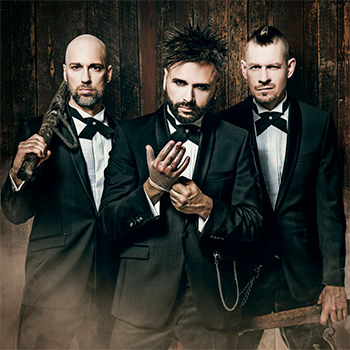
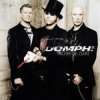
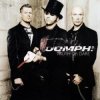
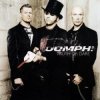
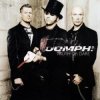
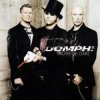
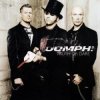
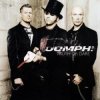
Oomph! — is a German rock band formed in Wolfsburg in 1989. The group is regarded as one of the pioneers of Neue Deutsche Härte (NDH), a style that combined heavy guitar music with industrial, EBM, electronic rhythms and predominantly German-language lyrics. Oomph! began developing this model before the term Neue Deutsche Härte became established within the German alternative scene of the mid-1990s.
The early combination of electronic sequences, mechanical rhythms and metal guitars in Oomph!’s music preceded the commercial rise of NDH and influenced the development of the style later associated with Rammstein, Megaherz, Eisbrecher and other German bands.
The name Oomph! comes from the English colloquial word oomph, which can refer to energy, drive, force, expressiveness or an extra impulse.
Formation and early years
Oomph! was founded in 1989 by three musicians who remained the core of the band for more than three decades:
- Dero Goi — vocals, lyrics, drums in the early period
- Flux — guitars, electronics, sampling
- Crap — guitars, keyboards and electronic instruments
Contrary to a common description of the classic line-up, Crap was not Oomph!’s permanent bass guitarist. Bass parts at concerts were performed by guest and session musicians at different stages of the band’s career.
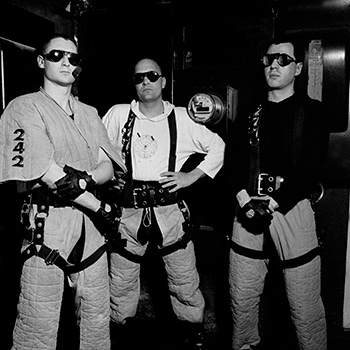
The band’s early sound was shaped by EBM, new wave, synth-pop and industrial electronics. The members cited Depeche Mode, Front 242, Nitzer Ebb and other representatives of the late-1980s European electronic scene among their musical influences.
The debut album Oomph! was released in 1992. It was based primarily on EBM, synthesizer parts, programmed rhythms and industrial electronics. Even on this record, the band used both English and German: the track list included Mein Herz, Der Neue Gott, Gleichschritt, Wir Leben and Ich Bin Du.
Sperm and the formation of Neue Deutsche Härte
A fundamental change in sound occurred on the second album, Sperm, released in 1994. The electronic foundation of the early recordings remained, but the guitars became significantly heavier, while elements of industrial metal and alternative metal entered the arrangements.
Sperm is regarded as one of the key releases in the early history of Neue Deutsche Härte. Oomph! began combining heavy riffs, electronic sequences, straightforward rhythms and German-language vocals before the first albums by several bands that would later become major representatives of NDH.
At the same time, there was no sudden “switch from English to German” in Oomph!’s history. The first two albums were already bilingual, and the proportion of German-language material increased gradually.
Defekt, Wunschkind and Unrein
On 1995’s Defekt, the band continued developing its combination of industrial electronics and metal guitars. The material became denser and more aggressive, although Oomph! still used both German and English.
The fourth studio album, Wunschkind, was released in 1996. It serves as an important link between the early electronic period and the more mature sound of the late 1990s. Heavy riffs became more prominent, as did the contrasts between electronic passages, melodic sections and aggressive vocals.
The 1998 album Unrein established the model that became associated with Oomph!’s classic sound: heavy guitars, programmed electronics, industrial rhythms and Dero Goi’s vocals shifting from restrained delivery to aggressive performance.
Plastik and Ego
On the 1999 album Plastik, the band expanded the melodic side of its material. The arrangements became more detailed, while the contrast between heavy and quieter sections became more pronounced. One of the best-known compositions from this period was Fieber, recorded with German singer Nina Hagen.
Ego followed in 2001. On this album, Oomph! continued combining industrial rock, electronic elements and alternative metal while placing greater emphasis on melodic choruses and song structure. The record concluded the period preceding the band’s greatest commercial success.
Augen auf! and the commercial breakthrough
2004 became a turning point in Oomph!’s mainstream popularity. The single Augen auf! topped the German chart and became the band’s most successful song.
The track appeared on the album Wahrheit oder Pflicht, which reached number two on the German albums chart and later achieved platinum status in Germany. Following its release, Oomph! significantly expanded its audience and began appearing regularly at major European festivals.
The success of Augen auf! did not mean abandoning the industrial component of the band’s sound. Oomph! retained heavy guitars and electronic programming but began using more concise verse-chorus structures and memorable vocal parts more frequently.
GlaubeLiebeTod
The album GlaubeLiebeTod was released in 2006. Its title combines the German words for “faith”, “love” and “death”, themes that repeatedly appear throughout the record’s lyrics.
One of its most discussed singles was Gott ist ein Popstar, built around a comparison between religious imagery and the mechanisms of modern mass culture. The release sparked public debate in Germany and attracted additional attention to the band beyond its traditional rock audience.
Träumst du also belongs to this period. A version of the song featuring vocals by Marta Jandová was released later.
Monster
The album Monster was released in 2008. Its songs address fear, aggression, sexuality, psychological conflict and destructive aspects of human behaviour.
Among the best-known compositions from this period are Labyrinth, Beim ersten Mal tut’s immer weh and Sandmann. Musically, the album combines heavy guitar parts with an electronic foundation, melodic choruses and quieter passages.
Truth or Dare
In 2010, Oomph! released Truth or Dare. This release should not be regarded as another full studio album consisting of new material.
Truth or Dare is made up primarily of English-language reworkings of previously released songs and was aimed at an international audience. It includes, for example:
- Ready or Not (I’m Coming) — the English-language version of Augen auf!
- God Is a Popstar — a version of Gott ist ein Popstar
- Crucified — a version of Gekreuzigt
- Sandman — a version of Sandmann
- True Beauty Is So Painful — a version of Beim ersten Mal tut’s immer weh
For this reason, Truth or Dare is usually treated separately from the official sequence of Oomph! studio albums.
Des Wahnsinns fette Beute
Des Wahnsinns fette Beute was released in 2012. It became one of the most stylistically diverse albums in Oomph!’s discography: alongside industrial metal and alternative rock, it features noticeable electronic, pop-rock and theatrical elements.
The band deliberately broadened the usual boundaries of its sound, which makes the album stand apart from the more stylistically consistent works of the late 1990s and 2000s.
XXV
In 2015, not 2016, Oomph! released the studio album XXV. The title referred to the band’s 25-year history.
The material combined characteristic Oomph! elements — heavy guitars, electronic sequences, German-language vocals and melodic choruses — without attempting to recreate the sound of any single earlier period in full.
Ritual and the first No. 1 in Germany
The album Ritual was released in January 2019. It became Oomph!’s final studio work with Dero Goi and, at the same time, one of the band’s most successful releases.
Ritual reached number one on the official German albums chart — the first such achievement in Oomph!’s history. On the record, the band once again emphasised the heavier side of its sound while retaining electronic programming and large melodic choruses.
Departure of Dero Goi
On September 29, 2021, Oomph! officially announced the end of its collaboration with Dero Goi. Flux and Crap stated that they would continue the band and search for a new vocalist.
The original statement did not disclose detailed reasons for the separation. Dero Goi later said in interviews that creative and personal disagreements had existed within the band for a long time, concerning music, lyrics and the group’s future direction.
Dero’s departure ended the era of the classic trio, which had existed for more than thirty years. His vocals had been one of Oomph!’s most recognisable elements, but Flux and Crap decided to retain the name and continue the project.
Der Schulz and the new line-up
In June 2023, Oomph! officially introduced its new vocalist, Daniel «Der Schulz» Schulz, previously best known as the frontman of the German band Unzucht.
Der Schulz joined Oomph! as a full member, participating not only in live performances but also in the creation of new material.
The current core line-up consists of:
- Der Schulz — vocals
- Flux — guitars, electronics, sampling
- CR4P — guitars, keyboards
Richter und Henker
Oomph!’s first studio album with Der Schulz was Richter und Henker, released in September 2023. It is the band’s fourteenth studio album.
The record retained the characteristic combination of industrial metal, heavy guitars, electronic elements and German-language vocals. At the same time, Der Schulz’s voice and his involvement in songwriting marked a distinct new stage in Oomph!’s history rather than an attempt to reproduce the Dero Goi period literally.
Social and political themes occupy a notable place in the album’s lyrics. Nur ein Mensch addresses the subject of war, while Wem die Stunde schlägt and the title track Richter und Henker continue Oomph!’s characteristic interest in power, conflict and human behaviour within society.
German musician Joachim Witt contributed to the recording of Wut. The album Richter und Henker reached number seven on the official German chart.
Musical style
Oomph! have gone through several noticeably different periods. The debut album was closely connected with EBM and industrial electronics, while heavy guitars had already taken a leading role by Sperm.
The main elements of the band’s later sound became:
- industrial guitar riffs
- electronic sequences and programmed rhythms
- a combination of aggressive and melodic vocals
- contrast between mechanical rhythms and song-oriented choruses
- elements of EBM, industrial rock, alternative metal and electronic music
- predominantly German-language lyrics
At the same time, Oomph! have never been restricted to a single Neue Deutsche Härte model. At different points, their music has incorporated synth-pop, alternative rock, gothic rock, dance elements and more traditional ballad forms.
Lyrical themes
Oomph!’s lyrics have repeatedly addressed religion, sexuality, power, violence, fear, the psychology of relationships and social conflict. Provocative themes are especially prominent on Sperm, Unrein, GlaubeLiebeTod and Monster.
However, the band’s discography cannot be reduced to a single philosophical concept. Themes and presentation changed from album to album: alongside social and religious subjects are songs about personal relationships, addiction, loneliness and internal conflict.
Influence on Neue Deutsche Härte
Oomph! are among the bands that helped shape the musical foundation of Neue Deutsche Härte before the name became a widely accepted genre term. The 1994 album Sperm is considered particularly important in this respect.
The combination of metal riffs, German vocals, industrial electronics and rigid rhythms was developed further on the German scene in the second half of the 1990s. Rammstein later became the best-known representative of this direction.
For this reason, Oomph!’s role in the history of NDH is more accurately described not as the absolute “invention” of the genre by a single band, but as one of the key sources of its musical language.
Oomph! discography
Studio albums
1992 — Oomph!
The debut album, based primarily on EBM and industrial electronics. Even on this record, the band used both German- and English-language lyrics.
1994 — Sperm
The release on which Oomph! significantly strengthened the guitar component and moved closer to the combination of industrial metal and electronics that later became one of the defining characteristics of Neue Deutsche Härte.
1995 — Defekt
A continuation of the heavier direction introduced on Sperm. Electronic sequences sit alongside dense riffs and bilingual vocal material.
1996 — Wunschkind
Oomph!’s fourth studio album. It develops the industrial-metal direction of the mid-1990s and forms an important part of the transition toward the sound of Unrein.
1998 — Unrein
One of the key albums of the band’s classic period. Heavy guitars, electronic sequences and Dero Goi’s vocal style combine here into the fully recognisable Oomph! sound.
1999 — Plastik
A more melodic and detailed album. Notable tracks include Fieber featuring Nina Hagen.
2001 — Ego
The album continued the move toward more structured songs while retaining industrial rock and an electronic foundation.
2004 — Wahrheit oder Pflicht
Oomph!’s major commercial breakthrough. The album reached number two in Germany, while Augen auf! became the most successful single in the band’s history.
2006 — GlaubeLiebeTod
An album built around themes of faith, love, death, religious symbolism and the relationship between the individual and mass culture. One of its best-known tracks is Gott ist ein Popstar.
2008 — Monster
The album combines heavy compositions with more melodic songs. Key singles include Labyrinth, Beim ersten Mal tut’s immer weh and Sandmann.
2012 — Des Wahnsinns fette Beute
One of the band’s most eclectic albums, combining industrial metal, alternative rock, electronic and more experimental elements.
2015 — XXV
A studio album whose title refers to Oomph!’s 25-year history. The recording combines elements from different periods of the band.
2019 — Ritual
The final studio album with Dero Goi. Ritual became the first Oomph! release to reach number one on the official German albums chart.
2023 — Richter und Henker
Oomph!’s fourteenth studio album and the first full-length release with Der Schulz. The record reached number seven in Germany.
Compilations and special releases
- 1998 — 1991–1996: The Early Works — a collection of the band’s early material
- 2006 — Delikatessen — a compilation of singles, well-known tracks, rarities and additional versions
- 2010 — Truth or Dare — English-language reworkings of previously released Oomph! songs
Selected Oomph! songs
- Der Neue Gott
- Gekreuzigt
- Fieber
- Augen auf!
- Brennende Liebe
- Gott ist ein Popstar
- Träumst du
- Beim ersten Mal tut’s immer weh
- Labyrinth
- Sandmann
- Alles aus Liebe
- Wem die Stunde schlägt
Oomph! today
The band did not cease activity after Dero Goi’s departure. Flux and CR4P retained Oomph!, while the arrival of Der Schulz in 2023 established a new permanent line-up.
Richter und Henker demonstrated that Oomph!’s modern phase retains the core elements of the band’s long-standing sound — heavy guitars, electronics and German-language lyrics — while developing new material with a different vocalist and co-writer.
The significance of Oomph!
Oomph!’s historical significance is primarily connected with the development of the combination of EBM, industrial rock and metal guitars from which Neue Deutsche Härte emerged during the 1990s. The album Sperm appeared before the commercial rise of the style, while the subsequent Defekt, Wunschkind and Unrein established its key musical characteristics.
The commercial success of Augen auf! in 2004 allowed the band to reach far beyond its original industrial audience, while Ritual reaching number one on the German albums chart in 2019 confirmed sustained interest in Oomph! three decades after the group’s formation. The change of vocalist in 2023 opened the next period in the band’s history without abandoning its industrial-metal foundation.