
 Yaktak
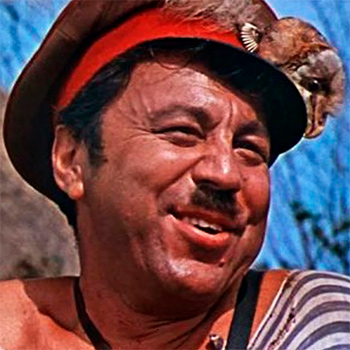
Mikhail Grigoryevich Vodyanoy (real surname — Wasserman; December 23, 1924, Kharkiv — September 11, 1987, Odesa) was a Soviet operetta performer, stage and film actor, singer, director and master of ceremonies. He was named People’s Artist of the Ukrainian SSR in 1964 and People’s Artist of the USSR in 1976. For more than three decades, his creative career was closely connected with the Odesa Musical Comedy Theatre, which was later named after him.
On stage, Vodyanoy created dozens of character and musical-comedy roles: Yashka Buksir in «Белая акация», Mishka Yaponchik in «На рассвете», Popandopulo in «Свадьба в Малиновке», Alfred Doolittle in «Моя прекрасная леди», Sancho Panza in «Человек из Ламанчи», Boni in «Сильва» and Tevye in «Скрипач на крыше». In cinema, his name is primarily associated with Popandopulo from the 1967 musical comedy «Свадьба в Малиновке».
Childhood and theatrical education
Mikhail Vodyanoy was born on December 23, 1924, in Kharkiv. During his teenage years, the family lived in Kislovodsk, where the future actor took part in amateur performances and developed an early interest in the stage.
In the early 1940s, he enrolled in the acting department of the Leningrad State Theatre Institute. According to the Encyclopedia of Modern Ukraine, Vodyanoy studied there from 1940 to 1943. World War II disrupted the normal course of his education, and he did not complete the full institute program.
Already in 1943, Vodyanoy began his professional stage career at the Pyatigorsk Musical Comedy Theatre. Thus, his career in operetta started during the war, before he had even turned twenty.
Pyatigorsk and his first professional roles
Vodyanoy worked at the Pyatigorsk Musical Comedy Theatre from 1943 to 1945. It was there that he acquired his first experience of regular work in a professional company: daily rehearsals, vocal parts, dance and spoken scenes, and the need to move quickly from one role to another.
Musical comedy proved to be the genre that brought together the qualities most characteristic of Vodyanoy as a performer: a sense of rhythm, singing ability, physical expressiveness, a talent for improvisation and the ability to build a vivid stage character not only through text but also through gesture, intonation and movement.
After the war, Vodyanoy moved to Lviv. For a time, he performed on the variety stage and later joined the company of the Lviv Musical Comedy Theatre.
Lviv Musical Comedy Theatre
The Lviv period became an important school of operetta for Vodyanoy. The theatre opened its first season in the spring of 1947, and Vodyanoy was among the performers who shaped its early history. Here he appeared in both classical operetta and contemporary musical repertoire.
His early roles included Boni in Imre Kálmán’s «Сильва», Mickey in Isaac Dunayevsky’s «Вольный ветер», Njegus in Franz Lehár’s «Весёлая вдова» and other character parts. Even then, Vodyanoy specialized less in the traditional romantic leading man and more in sharply defined characters requiring comic precision and freedom on stage.
At the Lviv theatre, he met actress Margarita Dyomina. Their stage partnership developed into a personal relationship, and they married in 1952. Dyomina later became one of the leading performers of the Odesa Musical Comedy Theatre and was awarded the title of People’s Artist of the Ukrainian SSR. The couple had no children.
The theatre moves to Odesa
At the end of 1953, the Lviv Musical Comedy Theatre was transferred to Odesa. Mikhail Vodyanoy and Margarita Dyomina moved there with the company. From that moment on, Odesa became the central city in the actor’s life and creative career.
Odesa material proved especially close to his acting style. He did not reduce the city’s stage image to a single accent or a set of jokes. His characters existed within a particular rhythm of speech and behavior: they could be restless, enterprising, theatrical and sometimes adventurous, while still remaining distinct from one another.
Over time, it was precisely his Odesa characters — above all Yashka Buksir and Mishka Yaponchik — that became an important part of Vodyanoy’s theatrical biography.
Yashka Buksir and «Белая акация»
One of Vodyanoy’s first major Odesa roles was Yashka Buksir in Isaac Dunayevsky’s operetta «Белая акация». The production directed by Izakin Grinshpun premiered at the Odesa Musical Comedy Theatre on January 29, 1956.
Dunayevsky worked on «Белая акация» as a work about Odesa and the people of a maritime city. Vodyanoy played Yashka — a quick-witted, self-confident and comic urban wheeler-dealer. The actor turned what was a secondary role in terms of plot into one of the production’s most memorable characters.
In 1957, the stage production «Белая акация» received a screen version: Georgy Natanson directed the musical film-performance of the same name, in which Vodyanoy once again played Yashka Buksir. The film was released in 1958 and helped make the performers of the Odesa Musical Comedy Theatre known far beyond the city.
Mishka Yaponchik and the Odesa theatrical theme
Another of Vodyanoy’s most important characters was Mishka Yaponchik in Oscar Sandler’s musical production «На рассвете». This was no longer simply a comic type. Vodyanoy built the role on a combination of outward bravado, theatricality within the character himself and the hero’s gradual movement toward collapse.
A whole cycle of productions developed around the Odesa theme, including «На рассвете», «Четверо с улицы Жанны» and «У родного причала». To a considerable extent, these productions defined the reputation of the Odesa Musical Comedy Theatre during this period.
In 1965, Vodyanoy brought the character of Mishka Yaponchik to the screen in the film «Эскадра уходит на запад». This role preceded his most famous film performance.
Popandopulo in «Свадьба в Малиновке»
In 1967, director Andrei Tutyshkin’s musical comedy «Свадьба в Малиновке» was released. Mikhail Vodyanoy played Popandopulo — the adjutant of Ataman Gritsian Tavrichesky.
Popandopulo is not the central character of the plot, yet Vodyanoy’s performance turned him into one of the film’s most memorable figures. His manner of speech, gait, facial expressions, costume and the couplets he performed formed a complete comic character. Lines spoken by the character were later widely quoted independently of the film itself.
«Свадьба в Малиновке» became one of the leaders of Soviet film distribution in 1967: approximately 74.6 million viewers saw the film. At the 3rd All-Union Film Festival in Leningrad in 1968, the prize for best comedy ensemble went to Zoya Fyodorova, Vladimir Samoilov, Mikhail Vodyanoy and Mikhail Pugovkin.
Although Popandopulo became Vodyanoy’s principal screen image for mass audiences, the actor himself remained above all a theatre performer.
From classical operetta to musical theatre
Vodyanoy’s repertoire was not limited to Odesa character roles. He played Boni in «Сильва», Zupan in «Марица» and Tony in Imre Kálmán’s «Принцесса цирка», Alfred Doolittle in Frederick Loewe’s musical «Моя прекрасная леди», Sancho Panza in «Человек из Ламанчи», and Agafon in Tikhon Khrennikov’s «Сто чертей и одна девушка».
His repertoire also included historical and dramatic characters. He played Paul I in «Дочь фельдмаршала» and later turned to the role of Tevye in «Скрипач на крыше». The latter role is particularly revealing: Vodyanoy, whom audiences were accustomed to seeing as a virtuoso comedian, was also capable of creating a character with considerably greater dramatic depth.
His stage manner was built on apparent ease. At the same time, colleagues remembered Vodyanoy as an exceptionally demanding performer: during rehearsals, he meticulously worked through intonations, movements and the rhythm of a scene, achieving the effect of improvisation only after the role had been carefully constructed.
Film career
Vodyanoy appeared in films far less often than he performed on stage, yet several of his screen roles became well known. His film characters often continued the approach characteristic of his theatre work: even a small or supporting role could be constructed as a complete and self-contained image.
- «Белая акация» — Yashka Buksir;
- «Наследники» — Yura;
- «Эскадра уходит на запад» — Mishka Yaponchik;
- «Свадьба в Малиновке» — Popandopulo;
- «Инспектор уголовного розыска» — Sosin;
- «Факир на час» — Akim;
- «Будни уголовного розыска» — Sosin;
- «Одиннадцать надежд» — San Sanych;
- «12 стульев» — journalist Persitsky;
- «Опасный возраст» — Lilia’s father;
- «Вольный ветер» — Georg Stan.
Thus, Vodyanoy’s filmography is relatively small. The main body of his creative work remained connected with musical theatre.
People’s Artist of the USSR
In 1957, Mikhail Vodyanoy received the title of Honored Artist of the Ukrainian SSR, and in 1964 he became People’s Artist of the Ukrainian SSR.
In 1976, he was awarded the title of People’s Artist of the USSR. Sources on the history of musical theatre describe Vodyanoy as the first Soviet operetta performer to receive this title. For a genre that had long occupied a less prestigious position than drama, opera and ballet, this had particular significance.
From 1972, Vodyanoy also headed the Odesa interregional branch of the Ukrainian Theatre Society and was involved not only in his own stage career but also in organizational matters concerning theatrical life in the region.
Leadership of the Odesa Musical Comedy Theatre
In the late 1970s, Vodyanoy moved into direct leadership of the theatre. From 1979 to 1983, he served as its artistic director; during the same period he also performed administrative duties, and after 1983 he continued working as the theatre’s director.
One of the main organizational tasks was securing a new building for the theatre. The old premises no longer matched the scale of the company and its productions. Vodyanoy actively campaigned for the construction of a theatrical complex designed specifically for musical comedy.
In 1981, the Odesa Musical Comedy Theatre moved into a new building at 3 Panteleimonivska Street. The modern theatre complex became one of the most visible results of Vodyanoy’s period in management.
Margarita Dyomina
Mikhail Vodyanoy’s wife, Margarita Ivanovna Dyomina, was also an operetta performer. They met at the Lviv Musical Comedy Theatre and married in 1952.
Dyomina performed lyrical-dramatic and character roles, and in 1974 she was awarded the title of People’s Artist of the Ukrainian SSR. The couple repeatedly appeared together in stage productions and concert programs and remained married until Vodyanoy’s death in 1987.
Final years
The final period of the actor’s life was difficult. In 1986, a criminal case was opened against Vodyanoy on charges of corrupting minors. Memoirs and journalistic publications contain numerous versions surrounding the case, including claims that the actor was deliberately persecuted and that the conflict was connected with leadership of the theatre.
Legally, the case ended without either an acquittal or a conviction. After Vodyanoy’s death, proceedings were terminated because of the defendant’s death — a ground that did not constitute rehabilitation. Therefore, categorical claims either that the actor’s guilt was proven or that he was acquitted by a court are incorrect.
Against the background of the investigation and years of intense work, Vodyanoy’s health deteriorated seriously. Sources report that he suffered several heart attacks.
On September 11, 1987, Mikhail Vodyanoy died in Odesa at the age of 62. He was buried at the Second Christian Cemetery.
Legacy
The association of Vodyanoy’s name with the Odesa Musical Comedy Theatre continued after his death. In 1995, the theatre was officially named after Mikhail Vodyanoy. In 2006, it received academic status.
The theatre’s repertoire later included the production «Бал в честь короля», dedicated to the actor. It brings together characters from productions in which Vodyanoy performed: Popandopulo, Mishka Yaponchik, Yashka Buksir, Tevye and others. The production remains part of the theatre’s repertoire history as a stage tribute to the performer.
A monument to Vodyanoy was erected at his grave in Odesa’s Second Christian Cemetery with the participation of his widow Margarita Dyomina. Odesa also has a star bearing the actor’s name on its Walk of Stars.
In his native Kharkiv, Vodyanoy’s memory is preserved in the city’s place names: in 2015, the former Shcherbakov Street was renamed Mikhail Vodyanoy Street.
Place in the history of musical theatre
Film audiences primarily remember Mikhail Vodyanoy as Popandopulo, but that role represents only a small part of his creative biography. His main field was operetta and musical theatre — from the classical works of Kálmán and Lehár to Soviet musical comedy and the Broadway musical.
His Odesa characters — Yashka Buksir, Mishka Yaponchik and Popandopulo — were distinct from one another, although all were built using similar acting tools: a precise sense of rhythm, physical expressiveness, musicality, immediate response to a stage partner and the ability to turn even a short line into a complete theatrical episode. Alongside them, Vodyanoy’s repertoire included Doolittle, Sancho Panza and Tevye — roles requiring a different degree of dramatic intensity.
It is theatre, rather than cinema, that forms the main body of Mikhail Vodyanoy’s legacy. His professional history also became part of the history of the Odesa Musical Comedy Theatre itself: from the transfer of the Lviv company to Odesa and the production of «Белая акация» to the construction of the new theatre building and the institution that today bears his name.