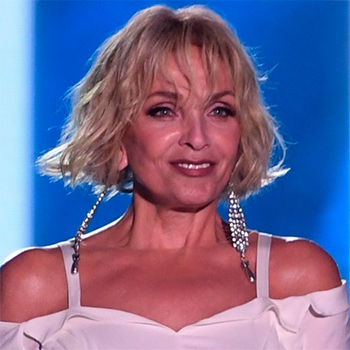
Laima Vaikule is a Latvian singer, actress and stage director. She was born on 31 March 1954 in Cēsis, Latvian SSR. She gained widespread recognition in the second half of the 1980s through songs by Raimonds Pauls and Ilya Reznik, including «Вернисаж», «Ещё не вечер», «Ночной костёр», «Деловая женщина» and «Скрипач на крыше». Her stage style developed at the intersection of pop music, estrada, cabaret, choreography and theatrical direction.
Early years
Laima Vaikule was born in Cēsis, but shortly after her birth the family moved to Riga. Her parents were not professional musicians: her father worked as a labourer, while her mother worked in retail. The musical member of the family was her grandmother, who sang in a church choir.
At the age of 12, Vaikule took part in a competition for young vocalists at the Palace of Culture of Riga’s VEF factory, received a diploma and began performing with musical ensembles. Later, she studied singing within VEF’s amateur arts system.
After the eighth grade, Laima entered a medical college. She studied there for several years and initially considered medicine to be her primary profession, while continuing to perform in parallel and gradually choosing the stage as her career.
First professional performances
While still a teenager, Vaikule auditioned for Raimonds Pauls, who was already one of the central figures in Latvian popular music. The first years of her professional career were connected with Riga’s estrada ensembles and long-running performances in restaurants and clubs.
In 1979, the singer began working at the famous Jūrmala variety venue Jūras pērle (“Sea Pearl”). This period became an important school of stagecraft for Vaikule. In its variety programmes, not only vocals but also choreography, costumes, movement, direction of individual numbers and interaction with the audience played major roles — elements that would later become characteristic features of her solo concerts.
GITIS and stage direction
In 1984, Vaikule enrolled in the directing faculty of the State Institute of Theatre Arts — GITIS. She studied acting and stage direction while continuing to perform.
Her professional directing education later became an important part of her work. Vaikule did not limit herself to performing songs, but also participated in the creation of concert programmes, choreography and the visual design of her own shows. The singer’s official biography directly links her studies at GITIS with her later work as a director of concert productions.
Breakthrough on the Soviet stage
In the mid-1980s, Vaikule began appearing on Central Television. In 1985, her dance-and-vocal miniature «Мухоморы» was shown, and in 1986 she performed «Ночной костёр», composed by Raimonds Pauls with lyrics by Ilya Reznik.
1987 became a turning point. Vaikule took part in Raimonds Pauls’ composer’s evening at the Rossiya State Central Concert Hall in Moscow, whose television broadcast significantly expanded her audience. Pauls’ official biography identifies this period as the beginning of the singer’s nationwide Soviet fame.
That same year, the release «Вернисаж» appeared. It included «Ещё не вечер», «Чарли», «Самый медленный поезд», «Пугало», «Шаляй-валяй», «Вернисаж», «Деловая женщина», «Шерлок Холмс» and «Ночной костёр». Vaikule herself later described this album as her first truly major success.
Raimonds Pauls and Ilya Reznik
The creative partnership between Laima Vaikule, Raimonds Pauls and Ilya Reznik defined the best-known period of her repertoire.
Pauls wrote music combining pop estrada, jazz harmonies, European schlager and elements of theatrical song, while Reznik’s lyrics made it possible to build complete stage narratives. The result was a series of compositions that became the foundation of Vaikule’s classic repertoire.
«Вернисаж», performed by Vaikule as a duet with Valery Leontiev, became particularly famous. Other key songs from this period included «Ещё не вечер», «Ночной костёр», «Деловая женщина» and «Скрипач на крыше», with music by Pauls and lyrics by Reznik.
In 1988, the album «Песни Раймонда Паулса и Ильи Резника поёт Лайма Вайкуле» was released, firmly documenting this songwriting partnership in her discography.
Bratislavská lýra
In 1987, Vaikule took part in the international popular song festival Bratislavská lýra in Czechoslovakia and received its highest award, the “Golden Lyre”. The victory became one of the singer’s first major international achievements.
A year later, Vaikule presented her own concert programme «Лайма Вайкуле поёт песни Раймонда Паулса» at the Rossiya Concert Hall in Moscow.
Work in the United States and Tango
At the turn of the 1980s and 1990s, Vaikule began working in the United States. She collaborated with American producers and musicians, including Michael Sembello’s studio, and later signed a contract with the MCA/GRP record company.
This period resulted in the English-language album Tango, released in the early 1990s. It differed from her familiar Russian-language repertoire and was aimed at the international market. Vaikule’s official discography dates the album to 1993.
The American period did not replace her main career in the countries of the former Soviet Union and the Baltics, but it gave the singer experience working with Western producers and a different model of studio production.
«Я вышла на Пикадилли»
The mid-1990s marked the beginning of another notable phase in Vaikule’s work.
One of its key songs was «Я вышла на Пикадилли», composed by Raimonds Pauls with lyrics by Viktor Pelenyagre. It was accompanied by a change in the singer’s visual image and became the basis for a new concert programme.
Vaikule’s official discography dates the album of the same name to 1996. It was recorded in the United States and continued her collaboration with Pauls while also expanding the circle of songwriters represented in her repertoire.
In 1996, she also released the Latvian-language album Viss nāk un aiziet....
«Латинский квартал» and «Зеркало»
In 1998, Vaikule released the album «Латинский квартал». The music was written and produced by Igor Krutoy, while the lyrics were written by Viktor Pelenyagre. The album was recorded in the United States and became the basis for the concert programme «Лайма в стиле танго».
In 1999, «Зеркало» followed. A significant part of the arrangements and studio work on the album was also carried out by American musicians and producers.
As a result, Vaikule’s repertoire expanded considerably during the 1990s: alongside Pauls’ classic songs appeared Latin American rhythms, tango elements, more contemporary pop production and new songwriting teams.
Musical and stage style
Laima Vaikule’s music is usually classified as pop music and estrada, although her stage format goes beyond the traditional performance of songs.
Her approach was already taking shape during her years at Jūras pērle, where a vocal composition functioned as part of a complete stage number. Choreography, costumes, lighting, pauses, movement and the dramatic development of a song have traditionally been as important to Vaikule as the vocal performance itself.
A distinctive feature of the singer is her recognisable low vocal timbre and performance style, which differed noticeably from the more academic Soviet estrada tradition of the 1980s.
The music itself also changed over time: Pauls’ repertoire combined pop, jazz and European estrada; tango and Latin influences appeared in the 1990s, while her later recordings exist within the framework of contemporary pop music.
Laima Rendezvous Jūrmala
In 2015, Vaikule created the international music festival Laima Rendezvous Jūrmala, held at the Dzintari Concert Hall in Jūrmala. The first festival lasted two days and brought together artists from Latvia and other countries.
In subsequent years, Rendezvous developed into a regular multi-day event. The festival is known for live performances with an orchestra, specially prepared duets and programmes bringing together Latvian and international musicians. The project continues to be held in the 2020s; the festival also took place in Jūrmala in 2026.
It is important to distinguish Laima Rendezvous Jūrmala from the Soviet competition for young performers «Юрмала». Vaikule was involved in the development of Jūrmala’s musical life as early as the Soviet period, but her own festival project bearing her name was launched specifically in 2015.
Later recordings
Vaikule continued recording music after the main album periods of the 1980s and 1990s.
In 2013, she released the Latvian-language album Atkal mājās featuring songs by Raimonds Pauls.
In the following years, she released individual singles, live recordings and new versions of classic material. In 2024, the Latvian-language track Saule Un Mēness appeared, followed in 2025 by «Танцуй» featuring Shura Bi-2, including both the original and remix versions.
Selected discography
Main albums and major releases:
- «Вернисаж» — 1987
- «Песни Раймонда Паулса и Ильи Резника поёт Лайма Вайкуле» — 1988
- Tango — 1993
- «Я вышла на Пикадилли» — 1996
- Viss nāk un aiziet... — 1996
- «Латинский квартал» — 1998
- «Зеркало» — 1999
- Atkal mājās — 2013
Key songs:
- «Ночной костёр»
- «Вернисаж»
- «Ещё не вечер»
- «Деловая женщина»
- «Скрипач на крыше»
- «Чарли»
- «Я вышла на Пикадилли»
- «Акапулько»
- «Латинский квартал»
Laima Vaikule today
Laima Vaikule’s career spans several distinct phases: her early work in Riga and Jūrmala estrada, nationwide Soviet success with songs by Raimonds Pauls, international studio projects, albums of the 1990s and her own festival activities. In her work, music has traditionally existed alongside direction, choreography and visual imagery, while Laima Rendezvous Jūrmala continues this concept in the format of an international concert festival.