

 Lola Young

Georgy Viktorovich Deliev is a Ukrainian actor, director, screenwriter, comedian, artist and musician, born on January 1, 1960, in Kherson. The defining work of his life became the Odesa comedy troupe “Maski”, where Deliev has spent decades as artistic director, director and actor. He is best known to a wide audience for the television series “Maski Show”, although his creative biography is much broader and also includes pantomime, theater, independent filmmaking, work with Kira Muratova, rock music and painting. In 2002, Deliev received the title of Honored Artist of Ukraine, and in 2009 he became a People’s Artist of Ukraine.
Architecture, pantomime and early performances
Deliev grew up in a family of teachers. In 1977, he entered the Faculty of Architecture at the Odesa Civil Engineering Institute and graduated in 1982. His student years ultimately determined the direction of his life: alongside architecture, he became interested in pantomime and clowning and trained in Odesa theater studios.
In the late 1970s, Deliev took part in productions that combined pantomime, physical theater and rock music. He later recalled working in the productions “Девушка и смерть” and “Голос Аэлиты”, which toured Moscow, Leningrad and Tallinn. It was during this period that his interest in physical theater definitively ceased to be merely a student hobby.
After graduating, Deliev worked in his profession for some time. In 1982–1984, he worked as an architect in Pyatigorsk and Chișinău while simultaneously organizing pantomime theater studios. During the same period, he continued to work professionally in the performing arts and collaborated with Vyacheslav Polunin’s theater “Лицедеи”.
His acquaintance with Polunin became one of Deliev’s most important creative schools. He was drawn not only to classical pantomime and clowning, but also to surrealist theater, absurdism, musical performance and a free approach to physical comedy. This combination later became one of the foundations of the artistic language of “Maski”.
The emergence of the professional “Maski” troupe
In 1984, Deliev joined the pantomime and clowning ensemble “Maski” at the Odesa Philharmonic. According to his own recollections, part of the troupe consisted of performers with whom he had already studied pantomime during his student years. Deliev was accepted as an actor and appointed artistic director; later he also took responsibility for a significant part of the directing work.
For this reason, the history of “Maski” is more accurately associated not with Deliev single-handedly creating the group, but with the transformation of an Odesa circle of mimes and clowns into a professional ensemble. Among the performers who shaped the troupe’s classic image were Boris Barsky, Vladimir Komarov, Alexander Postolenko, Natalia Buzko and others.
The first programs were built primarily around pantomime, physical comedy, grotesque humor and wordless routines. This language allowed the troupe to work with almost any audience regardless of language. The aesthetics of “Maski” combined silent cinema, circus clowning, commedia dell’arte, theater of the absurd and contemporary variety entertainment.
In 1986, Deliev became a prizewinner at the All-Union Competition of Variety Artists. At the same time, he continued his professional education: from 1986 to 1989, he studied at the State Institute of Theatre Arts in Moscow at the Faculty of Variety Directing.
From stage routines to “Maski Show”
Television gradually made “Maski” famous far beyond Odesa. One of the troupe’s early television successes was the number “Мана-Мана”, after whose broadcast, according to Deliev’s recollections, the group’s popularity rose sharply. The troupe toured increasingly often and began adapting its stage comedy into short television stories.
In the early 1990s, the project “Maski Show” appeared. From 1992 onward, Deliev directed around eighty television comedy films, working as director, screenwriter and one of the principal actors. Unlike a conventional television sketch show, many episodes were complete stories built around a single theme and visual dramaturgy.
Some of the best-known cycles were set in a hospital, the army, at a wedding, on a train, in court, in prison and in other easily recognizable situations. Dialogue was used sparingly, while most of the comedy was built around facial expression, movement, editing, music, sound effects and physical interaction between characters.
This principle made “Maski Show” understandable far beyond Ukraine. Deliev combined his experience in pantomime with the possibilities of television editing and turned relatively simple everyday situations into eccentric miniature films.
“Семь дней с русской красавицей” and his own directing work
Alongside “Maski”, Deliev also tried his hand at feature filmmaking. In the early 1990s, he worked as director, screenwriter and actor on the comedy “Семь дней с русской красавицей”. The film was made with direct participation from performers of “Maski” and transferred their grotesque theatrical aesthetic into a feature-length format.
Deliev later continued directing theater and screen projects, while his career as a dramatic film actor gradually became increasingly prominent.
Kira Muratova and “Настройщик”
A special place in Deliev’s filmography belongs to his collaboration with director Kira Muratova. He appeared in the films “Второстепенные люди”, “Чеховские мотивы” and “Настройщик”. These roles allowed audiences to see him outside his familiar television makeup and eccentric clowning.
In the 2004 film “Настройщик”, Deliev played one of the central roles — Andrey, a piano tuner and con man around whom the story is built. For this performance, he received the Best Actor award at the “Стожары-2005” film festival.
During the same period, he played Ostap Bender in the German adaptation of “Двенадцать стульев” directed by Ulrike Ottinger. The film was released in 2004 and became one of the more unusual interpretations of the novel by Ilf and Petrov.
In later years, Deliev continued appearing in films and television series. Among his notable works are “Мелодия для шарманки”, “Вечное возвращение”, “Донбасс”, “Одесский подкидыш”, “Крепость Хаджибей”, the series “Козаки. Абсолютно брехлива історія” and the comedy project “Юрчишины”.
“Дом клоунов” and the theatrical life of “Maski”
Despite their television success, “Maski” never abandoned theater. In 2003, the troupe opened its own theater center in Odesa — “Дом клоунов” on Olhiivska Street. For the opening, Deliev directed the production “Отелло”, based on a play by Boris Barsky.
The theater staged productions such as “Орфей и Эвридика”, “Ромео и Джульетта”, “Маски в кубе”, “Нон-стоп клоун” and others, preserving the troupe’s characteristic language of pantomime, physical comedy and theatrical absurdism.
Deliev continued working not only as a performer but also as a director, building productions around the individuality of specific actors. This theatrical line allowed “Maski” to exist independently of the television project and preserve its own repertoire after the most active period of “Maski Show” had ended.
Collaboration with Slava Polunin
Deliev’s connection with Vyacheslav Polunin did not end after his early work with “Лицедеи”. Already as the head of “Maski”, he repeatedly returned to Polunin’s projects, took part in his carnivals and theatrical experiments, and from the mid-2000s periodically appeared in Slava's Snowshow.
After moving to France, this collaboration became an especially important part of his stage activity. Deliev continued working with Polunin’s team, participating in productions and events at the creative center “Жёлтая мельница”, as well as touring with Slava's Snowshow.
Music
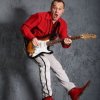
Music has accompanied Deliev throughout almost his entire professional life. In his youth, he already took part in productions featuring rock music, and later began performing as a songwriter, vocalist and guitarist in his own right. His work combines rock, blues, funk, rap, pop song and elements of musical theater.
In 2005, the album “Хулиган с большой буквы” was released with the Odesa euro-pop-rock group “Качели-Качели”, followed by “Дубда” in 2007. His third album, “Небесный поезд”, was completed and presented in 2008. Deliev worked on these projects not only as a singer but also as a songwriter.
Among Deliev’s better-known musical works are “Я плохой”, “Я реальный придурок”, “Небесный поезд” and “Тумба-Буги”. He recorded the latter together with Alena Vinnitskaya; the track appeared on her album “Куклы”.
Another notable work from this period was the song “Злые клоуны”, recorded by Georgy Deliev together with musician Alexey Bolshoy. In 2009, they filmed a provocative music video for it, directed by Deliev himself. The song was structured as a satirical dialogue between two “clowns” and mocked television, show business, musical fashion and mass culture. “Злые клоуны” was later added to the digital catalog of Alexey Bolshoy and Deliev.
Over the years, the musician also performed with his own group Deliev's Band, combining live music with elements of theatrical performance. In his shows, music frequently exists alongside acting, grotesque humor and the self-irony characteristic of Deliev.
Georgy Deliev’s music albums
- “Хулиган с большой буквы” — 2005
- “Дубда” — 2007
- “Небесный поезд” — 2008
Digital catalogs also contain compilations and reissues of Deliev’s songs, so the dates of some digital releases may differ from the original release dates of the material.
Painting
Deliev’s interest in visual art began long before he became famous as an actor. His architectural education continued to influence his visual thinking, while over time painting and graphic art developed into an independent creative direction.
Deliev works with oil, acrylic, watercolor, ink and pastel, creating portraits and narrative compositions. Solo exhibitions of his work have been held in Odesa and Kyiv; the Encyclopedia of Modern Ukraine records Odesa exhibitions in 2002, 2004 and 2006–2007, as well as a Kyiv exhibition in 2006.
Even in his painting, there is a clear connection with his theatrical thinking: many works are built around grotesque imagery, unusual characters or a visual story rather than purely decorative representation.
Awards and professional recognition
In 1986, Georgy Deliev became a prizewinner at the All-Union Competition of Variety Artists. In 2002, by decree of the President of Ukraine, he was awarded the title of Honored Artist of Ukraine as artistic director of the “Maski” comedy troupe.
On August 18, 2009, Georgy Deliev received the title of People’s Artist of Ukraine. The same decree awarded the title to his longtime “Maski” colleague Boris Barsky.
Deliev is also a member of the National Union of Cinematographers of Ukraine. For his leading role in “Настройщик”, he was honored at the “Стожары-2005” festival.
Personal life
Georgy Deliev’s first wife was Larisa Delieva, whom he met while studying architecture. They married during their student years and lived together for more than three decades. Their daughter Yana was born during the marriage and later also connected her life with the stage, taking part in her father’s projects. Larisa Delieva died in 2012.
In 2014, Deliev married singer Ekaterina Skripnik, who also participated in his musical project. Their son Nikolai was born in 2015, followed by a second son, Luka, in 2021.
After the beginning of Russia’s full-scale invasion of Ukraine, Deliev moved to France with his family. In a 2025 interview, the artist said that his second marriage had ended by that time, while he continued to take part in raising and supporting his sons.
France and a return to pantomime
Life in France gradually brought Deliev back to the theatrical form with which his career had originally begun. Working with Vyacheslav Polunin’s team and performing for international audiences, he once again focused on wordless comedy and pantomime.
This led to the creation of One Fool Show — a program developed from Deliev’s old and new solo routines. It began as a short one-man show, but gradually his daughter Yana joined the production, and an independent dramatic relationship developed between the two characters. In 2025, Deliev brought an updated version of the production to Odesa.
Despite living in France, the artist continues to visit Ukraine. At the same time, he tours with Polunin’s projects, paints and works on his own theatrical and musical ideas. In a 2025 interview, Deliev also spoke about his intention to form a new music group in France.
Selected filmography
- “Семь дней с русской красавицей” — early 1990s, actor, director and screenwriter
- “Второстепенные люди” — 2001
- “Чеховские мотивы” — 2002
- “Настройщик” — 2004, Andrey
- “Двенадцать стульев” — 2004, Ostap Bender
- “Мелодия для шарманки” — 2009
- “Вечное возвращение” — 2012
- “Донбасс” — 2018
- “Крепость Хаджибей” — 2020
- “Козаки. Абсолютно брехлива історія” — 2020
The style and significance of “Maski”
Deliev’s principal place in the history of Ukrainian comedy theater is connected with the fact that “Maski” managed to turn pantomime and professional clowning into a mass television format. Their comedy rarely depended on long dialogue or anecdotal monologues: character was revealed through gait, facial expression, costume, editing, sound and physical action.
This approach distinguished “Maski Show” from most comedy programs of its time. Deliev used techniques from silent cinema and circus clowning but transferred them into contemporary settings — a hospital, the army, a crime story or a family comedy. The television camera made it possible to intensify pantomime through close-ups, rapid editing and music.
At the same time, Deliev never limited himself to the role of a television comedian. His architectural education, training in pantomime, experience with Vyacheslav Polunin, independent filmmaking, music and painting shaped a much broader kind of artist. The same person could lead a theater, act in a Kira Muratova film, perform rock songs with a guitar and exhibit his own paintings.
It is this versatility that best characterizes Georgy Deliev’s creative biography. “Maski Show” made him recognizable to millions of viewers, but the foundation of his art remains a much older tradition — pantomime, clowning and visual theater. He has returned to it throughout his career: from student productions in Odesa and the first years of “Maski” to his collaboration with Slava Polunin and One Fool Show.