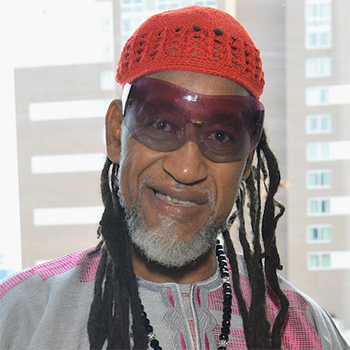
DJ Kool Herc is the person from whom the story of hip-hop begins—not simply as a genre, but as a cultural engine. His impact can’t be measured in charts or sales: he shaped the very principle by which the culture works—rhythm, the break, the street, sound, and community.
Origins and early years
His real name is Clive Campbell. He was born on April 16, 1955, in Kingston, Jamaica. In the late 1960s, his family moved to New York, settling in the Bronx—a borough that would experience a steep social decline in the 1970s.
The construction of the Cross Bronx Expressway effectively cut the area in two, triggering a large-scale middle-class exodus, rising poverty, and escalating street violence. In that environment, DJ Kool Herc’s parties became an alternative to street gangs—a space where competition played out through dance, sound, and style rather than aggression.
Jamaican roots and sound system culture
Herc’s childhood in Jamaica gave him a crucial advantage. He grew up with sound system culture—street parties powered by massive speakers, where the DJ was the central figure and the music was felt physically.
In New York, he recreated that approach by assembling his own audio system, The Herculords. By the early 1970s, it was the most powerful system in the Bronx, able to “drown out” any other sound in the neighborhood. For early hip-hop, The Herculords mattered as much as legendary guitars do in the history of rock.
August 11, 1973 — the starting point
On August 11, 1973, DJ Kool Herc threw a party at 1520 Sedgwick Avenue. Officially, it was a teen party. In reality, it marked the birth of hip-hop.
It was there that he first used the technique that would go down in history as The Merry-Go-Round.
Herc noticed that dancers reacted most intensely to the breaks—instrumental passages in funk records (James Brown, Jimmy Castor, The Incredible Bongo Band).
Using two copies of the same vinyl, he alternated between them, dropping the needle back to the key moment and artificially extending the break.
This created the foundation of breakdancing, the core of hip-hop DJing, and a prototype of what would later become sampling.
The role of the MC and the emergence of rap
DJ Kool Herc was not a rapper in the modern sense. His sets were accompanied by an MC whose job was to energize the crowd.
The key figure here is Coke La Rock. He is often regarded as the first MC in history to start shouting rhythmic, rhymed phrases into the microphone during Herc’s sets. This wasn’t rap as a genre yet—but rap would grow from exactly this.
Herc called the dancers who stepped into the center of the circle during breaks B-boys (break boys)—and that’s how breakdancing was born.
His place among the pioneers
DJ Kool Herc’s role is often described by comparison with other founders:
-
DJ Kool Herc — conceived the core principle
-
Grandmaster Flash — pushed the technique to technical perfection
-
Afrika Bambaataa — turned hip-hop into a philosophy and a movement
Without Herc, there would have been no second or third.
Why he doesn’t have a discography
DJ Kool Herc did not release classic studio albums. That isn’t a gap—it’s the historical norm.
In his era, hip-hop existed as:
-
a live street practice
-
sound shaped by the moment and the space
-
a culture passed hand to hand
The culture came before the industry—and that is the key to understanding his role.
Recognition and status today
DJ Kool Herc is officially recognized as a founding father of hip-hop:
-
inducted into the Rock and Roll Hall of Fame (Musical Influence category)
-
regularly involved in major museum and educational projects
-
the building at 1520 Sedgwick Avenue has been recognized as a cultural landmark
In 2023, he was an honored guest at the Grammy ceremonies marking hip-hop’s 50th anniversary, presented as a key figure in the culture’s origins.
At the same time, it’s important for historical accuracy that he does not have a Grammy Lifetime Achievement Award.
The significance of DJ Kool Herc
DJ Kool Herc is not an artist in the usual sense. He is a primary source.
Without him, hip-hop DJing would not exist, breakdancing would not have emerged, and rap would not have gained its rhythmic foundation.
He never became a show-business star, but he became an architect of a culture that reshaped music, fashion, language—and the very idea of what a “scene” can be.