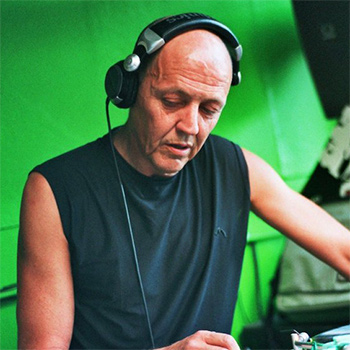
DJ Alfredo is a cult figure of global club culture — a man without whom it is impossible to imagine the birth of Balearic Beat and the very philosophy of Ibiza as a musical space of freedom. He was not a hit-making producer and never sought studio fame — his influence was built exclusively through DJ thinking, taste, and an exceptional ability to feel the moment. Alfredo laid the foundations of what would later become the global club aesthetic of the late 1980s and 1990s.
His real name is Alfredo Fiorito. He was born in Argentina, but his name is forever associated with Ibiza and the legendary club Amnesia.
Early years: from Argentina to Ibiza
Alfredo Fiorito was born in Argentina and began his journey not as a professional DJ, but as a music enthusiast with eclectic taste. He did not belong to an academic DJ school and did not follow strict genre boundaries — on the contrary, from the very beginning his approach was based on emotional intuition.
In the early 1980s Alfredo moved to Ibiza — an island that at the time was not yet a global club mecca, but rather a meeting place for hippies, artists, travelers, and seekers of alternative lifestyles. This environment shaped his musical philosophy: music as a state, not a format.
Amnesia and the birth of Balearic Beat
The key stage of DJ Alfredo’s career was his residency at the club Amnesia in the mid-1980s. His sets were radically different from the club standards of that era. Instead of rigid disco or linear dance rhythms, he freely mixed:
The tempo could shift from slow to danceable, the mood — from dreamy to euphoric. The absence of genre logic was a conscious artistic principle. This is how what would later be called Balearic Beat was born — not a genre in the classical sense, but an atmospheric approach to DJing.
Influence on the British club revolution
In the summer of 1987, a group of British DJs arrived in Ibiza — among them Paul Oakenfold, Danny Rampling, and Nicky Holloway. Experiencing Alfredo’s sets at Amnesia became a cultural shock for them.
This experience:
-
mixing styles
-
freedom from BPM constraints
-
emotional dramaturgy
-
connection with sunrise, nature, and space
became the starting point for the acid house revolution in the UK. Essentially, DJ Alfredo became an invisible architect of the British club scene, despite never seeking public recognition.
The philosophy of DJing
DJ Alfredo fundamentally rejected the idea of the DJ as a “dancefloor machine.” His approach can be summarized as:
-
music selected by feeling, not by genre
-
a set as a journey, not a playlist
-
silence and pauses are as important as the beat
-
sunrise is the climax, not the end
He played for people in an altered state of perception, but never adapted to trends or crowd expectations. That is why his sets are often remembered as a life experience, not just a night at a club.
The absence of a discography as a principle
Unlike most cult DJs, DJ Alfredo almost never released his own tracks. This was not a weakness — on the contrary, it emphasized his role as a pure selector and curator of moods.
His legacy exists in:
-
witness memories
-
fan-recorded mixes
-
stories told by DJs who changed the history of club culture
Alfredo is a rare example of a figure whose influence is inversely proportional to the number of official releases.
The decline of his career and final years
By the late 1990s and early 2000s, Ibiza’s club scene had changed dramatically: commercialization, the rise of EDM, and tourist-oriented formats pushed aside the atmosphere Alfredo embodied. He gradually withdrew from active performances, remaining an almost mythological figure.
DJ Alfredo passed away in 2024, but his death was not an ending — it was a reminder of the roots of club culture, before brands, lineups, and festival formats.
Interesting facts about DJ Alfredo
He deliberately ignored BPM and genres
At a time when DJs were already structuring sets by tempo, Alfredo could play a ballad after house, followed by a rock or dub track. This was not chaos:
he worked not with the dancefloor, but with the state of people.
He was effectively the first to make emotional dramaturgy more important than technical logic.
Sunrise was the climax, not the end of the night
Alfredo was known for building sets toward the morning, when people left the club, daylight entered the space, and the music became slower, warmer, and more intimate.
This practice later became fundamental for:
-
Balearic Beat
-
afterhours culture
He could play the same record several times in one night
If a track worked emotionally, Alfredo could:
-
bring it back an hour later
-
or play it again at sunrise
In an era when DJs were expected to “surprise with novelty,” this was radically against the rules.
He didn’t “create Ibiza” — he felt it
Importantly, Alfredo did not try to shape a scene. He simply played the island as he felt it: heat, sea, psychedelic relaxation, and the absence of time.
That is why Balearic Beat is not a style, but a geographical and emotional phenomenon.
He left almost no official recordings — by choice
Alfredo never sought to:
-
release albums
-
document his sets
-
turn himself into a brand
He believed that magic only works here and now.
That is why his influence was passed on orally — from DJ to DJ.
Notable and frequently quoted statements
“I never thought about styles. I thought about what people were feeling at that moment.”
— DJ Alfredo
This is essentially the quintessence of the Balearic approach.
“Music shouldn’t push people. It should guide them.”
“I didn’t play for the dancefloor. I played for the night.”
A formulation often quoted by British DJs when describing their first experience at Amnesia.
What others said about him
“We realized that a DJ could do everything. Not just mix records, but tell a story.”
Danny Rampling:
“Alfredo completely changed my understanding of what it means to be a DJ.”
Legacy and significance
Today, DJ Alfredo is:
-
the father of the Balearic Beat philosophy
-
a key figure in shaping acid house culture
-
a symbol of Ibiza as a space of freedom
-
an example of a DJ for whom taste matters more than technique
Without Alfredo, it is impossible to imagine the British club explosion of the late 1980s — or the very idea of the DJ as a conductor of emotions, not just a controller operator.
DJ Alfredo proved that sometimes all it takes is the right record at the right moment — and the history of music changes forever.